

Key Takeaways
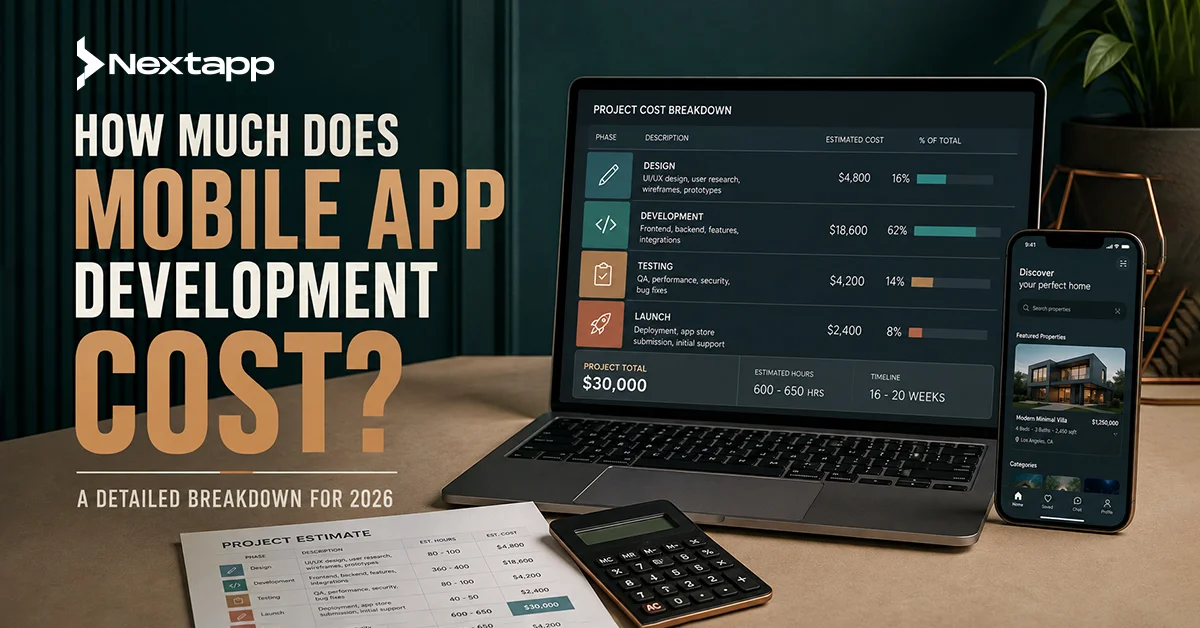
- The answer to how much does mobile app development cost in 2026 is: $15,000 to $50,000 for simple apps, $60,000 to $150,000 for mid-complexity apps, $150,000 to $500,000 for complex apps, and $500,000 or more for AI-powered enterprise platforms.
- App complexity is the primary cost driver. The transition from mid-level to advanced apps produces a 2x to 3x cost increase, primarily driven by AI features, real-time systems, and multi-role architectures.
- Cross-platform development using Flutter or React Native reduces cost by 20 to 40% versus building separate native iOS and Android apps while still reaching both audiences.
- Developer location is the most controllable cost variable. North American rates run $100 to $250 per hour. Eastern European rates run $40 to $80. Indian and Southeast Asian rates run $15 to $50.
- Post-launch maintenance costs 15 to 25% of the original build cost annually. A $100,000 app requires at least $20,000 per year to stay secure, OS-compatible, and competitive.
- Hidden costs including third-party API fees, App Store developer accounts, cloud infrastructure, and QA automation, consistently add 20 to 30% above the initial development quote if not explicitly budgeted.
- An MVP-first approach reduces initial investment by 40 to 60% and allows market validation before committing full production budget.
Introduction
The most common question in mobile product development is also the hardest to answer simply: how much does mobile app development cost? The honest answer is that it depends on decisions you have not made yet. Platform choice, feature complexity, design requirements, backend architecture, team location, and post-launch maintenance commitments all independently affect the final number. A two-word answer is always misleading.
What is not misleading is data. Based on a Goodfirms survey of 267 mobile app development companies and publicly available benchmarks from Clutch, Appinventiv, and Cynoteck, mobile app development cost in 2026 ranges from $15,000 for minimal viable products with basic functionality to $500,000 or more for complex, AI-integrated enterprise platforms. The global mobile app market is worth over $935 billion, and understanding where your product sits in that cost spectrum is the prerequisite for making a budget decision that does not collapse mid-project.
This guide breaks down every cost variable in the process of how much mobile app development costs in 2026, with real numbers for each category and practical guidance on how to reduce cost without reducing quality.
Mobile App Development Cost by Complexity
Simple Apps: $15,000 to $50,000
Simple apps cover utility tools, basic information apps, single-function consumer apps, and MVPs with a minimal feature set. These apps include user authentication, a small number of screens (typically five to ten), static content, and basic push notification support. They have no real-time features, no complex backend, and no third-party payment integration. Build time runs three to six months with a small team.
Examples include a business card scanner, a basic appointment reminder, a restaurant menu app, or a simple content delivery app where users browse and read information. For startups validating a product concept before committing full investment, this tier represents the entry point for a professionally built app that provides real validation data.
Mid-Complexity Apps: $60,000 to $150,000
Mid-complexity apps include social features, marketplace mechanics, third-party API integrations, payment processing, user-generated content, real-time notifications, and multi-role user systems. Build time runs six to twelve months. Examples include e-commerce apps, appointment booking platforms, fitness tracking apps with wearable integration, and delivery tracking apps.
This is the tier where most commercial mobile app projects land. It includes the features that create real user engagement and business value while remaining within the budget range that most funded startups and established SMEs can access without enterprise-scale financing.
Complex Apps: $150,000 to $500,000
Complex apps include real-time features (live chat, live location tracking, real-time collaborative editing), advanced AI integration, multi-sided marketplace architecture, streaming capabilities, complex payment and financial transaction systems, and enterprise-grade security requirements. Build time runs twelve to twenty-four months.
Fintech apps requiring PCI-DSS compliance, healthcare apps requiring HIPAA-compliant data architecture, and ride-sharing or delivery platforms requiring real-time driver location tracking all fall in this tier. The cost premium over mid-complexity apps reflects the engineering depth required for compliance, real-time infrastructure, and the testing complexity of systems that handle sensitive user data at scale.
Enterprise and AI-Powered Apps: $300,000 to $1,000,000+
Enterprise apps and AI-powered platforms combine all the complexity of the previous tier with large-scale data processing, machine learning model integration, multi-region deployment, regulatory compliance across multiple jurisdictions, and the security auditing requirements of organizations handling enterprise data. Build time is typically eighteen to thirty-six months for full-scale delivery.
How Feature Complexity Affects Mobile App Development Cost
Features are the most direct driver of mobile web app development cost within any complexity tier. Some features are straightforward to build. Others require complex architecture decisions, specialist expertise, and extended testing cycles that multiply their apparent cost significantly.
User authentication and registration (email, social login, biometric): $3,000 to $8,000. Payment and subscription integration (Stripe, PayPal, App Store in-app purchases): $8,000 to $25,000 including fraud logic and compliance. Real-time chat (WebSocket infrastructure, message history, push notifications): $15,000 to $35,000. GPS and location tracking (real-time driver tracking, geofencing, route optimization): $12,000 to $30,000. AI and machine learning integration (recommendation engine, image recognition, predictive features): $20,000 to $80,000 depending on model complexity. Video streaming (live or on-demand, encoding, CDN infrastructure): $25,000 to $60,000.
Every additional feature increases development time, backend logic, testing effort, and long-term maintenance. Focusing on must-have features at launch and deferring nice-to-have features to a post-launch roadmap is the most effective way to reduce initial mobile app development cost without compromising the user value of the product.
Platform Choice and Mobile App Development Cost
Platform choice directly impacts budget and has consequences that play out for years. Three primary platform strategies exist in 2026.
Native iOS only (Swift): Lowest single-platform cost due to iOS's smaller device matrix and more consistent development environment. iOS app development is typically 10 to 15% faster than Android due to ecosystem consistency. Appropriate for products targeting premium consumer markets where iOS users represent the primary audience. Cost advantage disappears when Android is added later because two codebases require independent maintenance.
Native Android only (Kotlin): Broadest device coverage for global markets where Android commands 71% of active users. Android requires 15 to 20% more testing time due to device fragmentation. Appropriate for products targeting markets in Southeast Asia, South Asia, Latin America, and Africa where Android dominance is most pronounced.
Cross-platform (Flutter or React Native): Reduces cost by 20 to 40% versus building separate native apps by maintaining a single shared codebase that compiles to both iOS and Android. Flutter (Dart) delivers near-native performance with its own rendering engine. React Native (JavaScript/TypeScript) uses platform-native UI components. For most commercial apps in 2026 that do not require advanced hardware integration or maximum performance optimization, cross-platform delivers the most cost-efficient path to both markets simultaneously.
Geographic Location and Developer Rates
Developer location is the most controllable variable in how much does mobile app development cost for any project. Hourly rates by region in 2026:
North America (US and Canada): $100 to $250 per hour for experienced mobile developers. Western Europe (UK, Germany, France): $80 to $200 per hour. Central and Eastern Europe (Poland, Ukraine, Romania): $40 to $80 per hour with strong technical quality. India: $15 to $50 per hour. Southeast Asia (Philippines, Vietnam): $20 to $50 per hour. Latin America (Mexico, Colombia, Argentina): $40 to $70 per hour with US time zone alignment.
For a mid-complexity app requiring 2,500 hours of development time: at US rates of $150 per hour, the cost is $375,000. At Eastern European rates of $60 per hour the cost is $150,000. At Indian rates of $30 per hour the cost is $75,000. Hiring developers from India or Eastern Europe reduces mobile app development cost by up to 60% on direct labor.
Third-Party API Integration Fees
Third-party API integrations add cost beyond the development hours required to integrate them. Each integration also requires error handling, testing, and ongoing maintenance as external services update their APIs. Common integration costs in 2026:
Payment gateways (Stripe, PayPal, Braintree): $0 to $50 per month in platform fees plus $8,000 to $20,000 in integration development. Mapping and location services (Google Maps Platform): $0.002 to $0.007 per API call at scale. Push notification services (Firebase Cloud Messaging): free at low volume, $0.0008+ per notification at high volume. Authentication providers (Auth0, Cognito): $0.0055 per monthly active user above free tier. Video API (Twilio, Daily.co): $0.004 to $0.01 per participant per minute. CRM integrations (Salesforce, HubSpot): $3,000 to $15,000 in integration development plus subscription costs.
Backend Complexity and Database Architecture Costs
Backend development has become more expensive in 2026 due to the requirement for real-time data processing capabilities, scalable cloud infrastructure, and AI integration readiness. Backend costs in a complete mobile app project typically account for 25 to 35% of total development spend.
Simple backend (user authentication, basic CRUD operations, cloud storage): $8,000 to $25,000. Standard backend (REST APIs, push notifications, payment processing, admin dashboard): $20,000 to $60,000. Complex backend (real-time WebSocket connections, microservices architecture, machine learning model serving, multi-region deployment): $60,000 to $200,000.
Backend infrastructure also carries ongoing cloud hosting costs. AWS, Google Cloud, and Azure all price based on usage. Realistic monthly cloud costs range from $50 to $200 for simple apps with modest user volume to $2,000 to $10,000 for apps serving thousands of concurrent users with real-time features.
Visual Design Costs
Design directly affects user retention and conversion. Poor design is the leading cause of app abandonment, with 88% of users not returning after a bad experience. Design costs in 2026:
Standard design using platform UI components (iOS Human Interface Guidelines, Android Material Design): $8,000 to $15,000. Custom UI with branded components, custom icons, and animated interactions: $15,000 to $40,000. Premium design with complex animations, custom illustration, and high-fidelity prototyping: $40,000 to $80,000. Custom designs increase cost by 40 to 50% over standard components but deliver the differentiated visual experience that commands App Store ratings above 4.5 stars.
Ongoing Maintenance and Hosting Costs
Post-launch maintenance is the cost dimension most frequently omitted from initial mobile app development cost planning. Annual maintenance runs 15 to 25% of the original build cost. A $100,000 app requires at least $20,000 per year in maintenance to remain secure, OS-compatible, and competitive.
Maintenance covers four categories. OS compatibility updates: Apple and Google release major OS versions annually. Apps that do not update for compatibility see declining session rates as users upgrade their operating systems. Security patches: new vulnerabilities are discovered continuously. Patching critical security issues is non-negotiable for any app handling user data. Feature additions: user expectations evolve. Apps that receive no feature updates after launch lose ground to competitors that continue improving. Bug fixes: production bugs discovered after the warranty period are billed as maintenance work.
QA and security testing should consume 15 to 20% of total build budget. A $100,000 project should allocate $15,000 to $20,000 specifically to testing across the device matrix, automated regression suite setup, and security review.
How to Reduce Mobile App Development Cost Without Reducing Quality
Five strategies consistently reduce mobile app development cost while protecting quality. Start with an MVP that includes only the features that validate the core value proposition. Validate user demand with the MVP before committing the full production budget to the complete feature set. MVP-first approaches reduce initial investment by 40 to 60%. Choose cross-platform development over native dual-platform for all apps where advanced hardware integration is not required. Flutter or React Native saves 20 to 40% on development cost while maintaining near-native performance for standard commercial apps. Select an Eastern European or Latin American development team if time zone alignment and technical quality are the primary criteria. Rates of $40 to $80 per hour deliver professional-grade output at 50 to 65% below North American rates. Define your requirements completely before approaching vendors. Vague requirements produce vague quotes that carry hidden cost risk. Complete requirement documentation allows fixed-price contracting for stable scopes. Budget 15 to 20% above the development quote for scope adjustments, third-party integration fees, and testing costs. Projects that hit scope expansion without a pre-allocated buffer consistently exceed budget by 25 to 40%.
Conclusion
The answer to how much does mobile app development cost in 2026 is a range that your specific decisions shape into a specific number. App complexity, platform choice, developer location, feature set, design quality, backend architecture, and post-launch maintenance commitments all contribute. No honest vendor can give you a reliable quote without understanding all of these dimensions.
What this guide provides is the framework to understand those dimensions before the first vendor conversation. A simple app validating a new concept costs $15,000 to $50,000. A commercially competitive mid-complexity app costs $60,000 to $150,000. A complex platform with real-time features and compliance requirements costs $150,000 to $500,000. Annual maintenance adds 15 to 25% of the build cost per year regardless of tier.
If you are ready to get an accurate, scoped estimate for your specific project, Next App delivers complete mobile app development across iOS, Android, Flutter, React Native, and full-stack backend. Contact our team for a detailed project quote based on your actual requirements.
Frequently Asked Questions (FAQs)
How much does a simple mobile app cost in 2026?
A simple mobile app with basic functionality costs $15,000 to $50,000. This range covers user authentication, a small number of screens, basic content delivery, and simple push notifications. It does not include payment processing, real-time features, or complex backend architecture.
What is the average cost of developing a mobile app?
The average cost across all complexity tiers is approximately $80,000 for a commercially viable mobile app that gains real traction. This figure from Goodfirms represents the median investment for apps with real user functionality including authentication, profiles, basic social features, and backend data management.
Is cross-platform development cheaper than native?
Yes. Cross-platform development using Flutter or React Native reduces cost by 20 to 40% versus building separate native iOS and Android apps. For most commercial apps without advanced hardware integration requirements, cross-platform delivers equal performance at significantly lower cost. Native development is only necessary for AR/VR, high-performance gaming, and apps requiring maximum device-specific hardware access.
What are the hidden costs of mobile app development?
Hidden costs consistently overlooked in initial planning include: App Store developer account fees ($99 per year for iOS, $25 one-time for Android), third-party API usage fees, cloud hosting and server costs, post-launch maintenance and OS update compatibility, QA testing across the device matrix, and ASO (App Store Optimization) for launch visibility. These add 20 to 30% above the core development quote when not explicitly budgeted.
How does location affect mobile app development cost?
Location is the most controllable cost variable. North American developers charge $100 to $250 per hour. Eastern European developers charge $40 to $80 per hour at comparable quality. Indian developers charge $15 to $50 per hour. For a 2,500-hour project, the cost difference between US and Indian rates is $125,000 to $375,000 in direct labor savings. Hybrid models combining US product management with Eastern European or Indian development execution are the dominant cost-efficiency approach for mid-market companies in 2026.
Should I build for iOS or Android first?
Build for both simultaneously using Flutter or React Native unless you have a specific reason to prioritize one platform. Cross-platform frameworks eliminate the "which first" decision by allowing a single team to deliver both platforms from one codebase. If budget constraints require a single-platform start, choose the platform where your target user demographic is most active. iOS users generate higher average revenue per user in developed markets. Android commands 71% global market share by volume.