

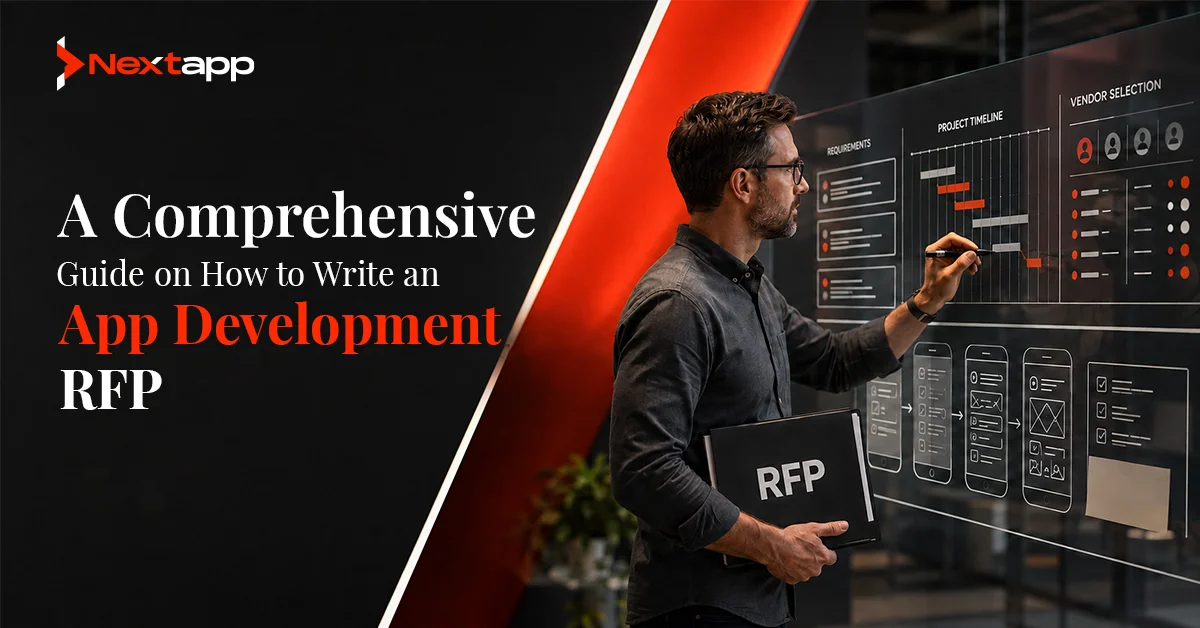
Learning how to write an app development RFP helps you find the right development partner, compare proposals fairly, and reduce confusion before your mobile app project begins. An app development RFP, or request for proposal, is a formal document that explains your project overview, business goals, functional requirements, technical expectations, budget range, timeline, selection criteria, and expected deliverables.
A strong RFP gives vendors enough information to understand your app vision and submit accurate proposals. It also helps your team avoid vague pricing, unrealistic timelines, unclear scope, and poor vendor fit. Whether you are building a mobile app for customers, employees, partners, ecommerce, bookings, education, healthcare, finance, or internal operations, a well-written RFP can protect your budget and create a smoother development process.
The goal of an app development RFP is not to make the document complicated. The goal is to make the project clear.
What Is an App Development RFP?
An app development RFP is a document a business sends to software development companies or app development agencies when it wants proposals for a mobile app project. The RFP explains what the app should do, who it is for, what problems it should solve, what technical needs it may have, and how vendors should respond.
It gives all shortlisted vendors the same information so their proposals can be compared more fairly. Without an RFP, one vendor may quote for a basic MVP, another may quote for a full product, and another may leave out design, testing, or post-launch support. This makes comparison difficult.
An app development RFP is especially useful when the project has multiple stakeholders, a fixed budget range, a defined launch goal, or a complex feature set. It is also helpful when procurement, legal, finance, or leadership teams need a clear record of vendor evaluation.
Why an App Development RFP Matters
A mobile app can involve design, frontend development, backend systems, APIs, databases, cloud hosting, analytics, security, testing, app store submission, and long-term maintenance. If those expectations are not documented, misunderstandings can happen quickly.
A good RFP helps vendors understand the project before they estimate the cost. It also helps your business identify vendors who think strategically and ask the right questions.
The RFP process can reveal how a company communicates, how it approaches discovery, how it structures timelines, and whether it understands your industry. A thoughtful vendor will respond with questions, recommendations, risks, assumptions, and a clear plan. A weak vendor may send a generic proposal without addressing your actual needs.
Start With a Clear Project Overview
The project overview is the first major section of your app development RFP. It should explain the app idea in simple language. Vendors should be able to read this section and understand what you want to build, who will use it, and why it matters.
The project overview should include the app name if available, the type of app, the target users, the main problem the app solves, and the desired outcome. Keep it clear and direct.
For example, instead of writing, “We need an app for our customers,” write, “We need a mobile app that allows customers to book appointments, manage service requests, receive notifications, and track order status from their phones.”
This gives vendors a better starting point.
What to Include in the Project Overview
Your project overview should include a short description of your company, the purpose of the app, the audience, the current problem, and the desired business result.
You can also explain whether the app is a new product, a replacement for an existing app, an internal tool, or an extension of your website or software platform.
If the app connects to existing systems, mention that early. Vendors need to know whether the project involves CRM tools, ecommerce platforms, payment gateways, ERPs, booking systems, learning platforms, or custom databases.
Define Your Business Goals
Business goals explain why you are building the app. This section helps vendors understand the commercial purpose behind the technical work.
Your app may be designed to increase customer engagement, reduce manual work, improve service delivery, generate revenue, support subscriptions, collect leads, improve communication, or create a new digital product.
Clear business goals help vendors recommend the right features. If your main goal is speed to market, they may recommend an MVP approach. If your goal is long-term scalability, they may focus more heavily on architecture. If your goal is revenue, they may prioritize payment flows, analytics, onboarding, and conversion paths.
Examples of Business Goals for an App RFP
Your business goals may include increasing online bookings, reducing support calls, improving customer retention, building a paid subscription product, improving employee productivity, expanding ecommerce sales, launching a marketplace, or creating a better digital experience for existing users.
A strong RFP does not only say what the app should include. It explains what success means for the business.
Describe the Target Users
The target user section explains who will use the app. This is important because user needs shape design, features, navigation, language, accessibility, onboarding, and technical decisions.
An app for busy parents will be different from an app for field technicians. An app for doctors will be different from an app for students. An app for enterprise teams will be different from a public consumer app.
Include any available user details. This may include age group, location, technical comfort level, device preference, user roles, pain points, and expected behavior.
User Roles and Permissions
Many apps have more than one user role. A marketplace app may have buyers, sellers, and administrators. A healthcare app may have patients, doctors, nurses, and clinic managers. An education app may have students, teachers, parents, and admins.
List each role and explain what each user should be able to do. This helps vendors understand the complexity of permissions, dashboards, workflows, and backend management.
List Functional Requirements
Functional requirements explain what the app must do. This is one of the most important parts of an app development RFP.
Functional requirements may include user registration, login, profiles, search, booking, payments, messaging, push notifications, content management, admin dashboards, location tracking, file uploads, analytics, subscriptions, ratings, reviews, and social sharing.
Write functional requirements in clear, practical terms. You do not need to write code or technical specifications, but you should explain the expected user actions.
For example, instead of writing, “The app needs booking,” write, “Users should be able to view available time slots, book an appointment, receive confirmation, reschedule if allowed, and get reminder notifications.”
This gives vendors a clearer understanding of the work involved.
Separate Must-Have Features From Future Features
Feature prioritization is important. Many app projects become too large because every idea is treated as essential.
Divide features into three categories: must-have, nice-to-have, and future phase. Must-have features are required for launch. Nice-to-have features are useful but not critical. Future phase features can wait until after the first release.
This helps vendors propose realistic timelines and budgets. It also helps prevent the MVP from becoming too complicated.
Include Non-Functional Requirements
Non-functional requirements explain how the app should perform, not just what it should do. These requirements are often overlooked, but they are critical for app quality.
Non-functional requirements may include performance, scalability, security, availability, accessibility, usability, compatibility, privacy, maintainability, and compliance.
For example, you may require the app to load key screens within a certain time, support a specific number of users, work on certain iOS and Android versions, meet accessibility standards, or comply with industry regulations.
Common Non-Functional Requirements
Common non-functional requirements include fast page loading, secure login, encrypted data storage, smooth performance on mobile devices, clean error handling, backup processes, role-based access, crash monitoring, and compatibility with tablets or older devices.
These requirements help vendors understand quality expectations. They also help reduce disagreements later when the app works technically but does not meet performance or usability standards.
Explain Technical Constraints
Technical constraints are existing conditions the development team must work within. This may include required platforms, existing systems, approved tools, hosting preferences, security policies, compliance standards, legacy software, or internal IT requirements.
If your company already uses a specific backend, CRM, payment system, database, CMS, or cloud provider, mention it in the RFP. If the app must integrate with existing APIs, explain that as well.
Technical constraints help vendors decide whether they have the right skills. They also help avoid proposals that recommend tools your business cannot use.
Examples of Technical Constraints
Technical constraints may include using AWS, Azure, or Google Cloud, connecting with Salesforce, integrating with Shopify, supporting an existing website login, using a specific payment gateway, following HIPAA requirements, meeting SOC 2 standards, or working with an internal database.
If you are unsure about technical constraints, say so. A good vendor can help you identify them during discovery.
Mention the Desired Stack if You Have One
The desired stack section explains any preferred technologies. You may want a native iOS app, native Android app, cross-platform app, Flutter app, React Native app, Kotlin-based app, Swift app, or web-based mobile experience.
You may also have backend preferences such as Node.js, Laravel, Python, Ruby on Rails, .NET, Firebase, Supabase, AWS, or custom APIs.
Only include a desired stack if you have a real reason. If your team does not have a technical preference, ask vendors to recommend the best stack and explain their reasoning.
Keep Technology Decisions Flexible When Possible
Some businesses enter the RFP process with a fixed technology choice without knowing whether it fits the project. This can limit better recommendations.
You can write, “We are open to vendor recommendations, but the proposed technology stack should support scalability, security, performance, and long-term maintenance.”
This gives vendors room to propose the right approach.
Provide a Budget Range
Including a budget range helps vendors shape realistic proposals. Some businesses avoid sharing budget because they worry vendors will price to the maximum. However, no budget guidance can lead to proposals that are too expensive, too limited, or impossible to compare.
A budget range helps vendors recommend the right scope. It also prevents wasted time with companies that are not a financial fit.
For example, a vendor will approach a $30,000 MVP differently than a $250,000 full-scale platform. Both may be valid, but they require different planning.
How to Share Budget Without Losing Control
You can present your budget as a range and ask vendors to explain what can be achieved within it. For example, “Our expected budget range for the first release is $60,000 to $90,000. Vendors should explain what is included, what assumptions are being made, and which features may require a later phase.”
This keeps the conversation practical while still allowing comparison.
Define the Timeline and Submission Deadlines
Your RFP should include the submission deadline for vendor proposals, the evaluation timeline, expected decision date, and desired project start date.
Vendors need enough time to review the RFP, ask questions, estimate effort, and prepare a thoughtful proposal. Short deadlines often lead to generic responses.
Also include your desired launch timeline if known. If the deadline is tied to an event, funding milestone, seasonal campaign, or business requirement, explain that clearly.
Important Timeline Details to Include
Include the date the RFP is issued, the deadline for vendor questions, the proposal submission deadline, the shortlist date, interview dates, final decision date, contract signing target, project kickoff date, and expected launch window.
These details create structure and help vendors plan their response.
Provide Stakeholder Contact Information
Stakeholder contact information tells vendors who to contact with questions and who is involved in the decision-making process.
Include the name, role, email address, and preferred communication method for the primary contact. If there are technical, legal, procurement, or product stakeholders involved, explain when they will participate.
Clear contact information prevents confusion and keeps vendor communication organized.
Keep Vendor Questions in One Place
For larger RFPs, it is helpful to collect vendor questions and answer them in one shared document. This gives every vendor access to the same information and keeps the process fair.
You can also schedule a vendor Q&A session if the project is complex.
Explain Expected Deliverables
Expected deliverables define what the vendor should provide during and after the project. Deliverables may include discovery documents, wireframes, UI designs, prototypes, source code, backend systems, APIs, admin panels, QA reports, deployment support, documentation, training, app store submission, and maintenance plans.
Being specific about deliverables helps avoid later disputes. For example, one vendor may include Figma design files, while another may not. One vendor may include deployment support, while another may charge extra.
Common App Development Deliverables
Common deliverables include product roadmap, technical specification, user flow diagrams, wireframes, UI design, clickable prototype, frontend code, backend code, database setup, API documentation, admin dashboard, testing plan, QA report, app store assets, launch support, and post-launch maintenance plan.
Ask vendors to confirm which deliverables are included in their proposal.
Define Project Milestones
Milestones break the project into manageable stages. They help your team track progress, approve work, and connect payments to completed phases.
Common milestones include discovery, wireframing, UI/UX design, technical planning, frontend development, backend development, API integration, QA testing, user acceptance testing, app store submission, launch, and post-launch support.
A vendor should explain how milestones will be managed and what your team needs to approve at each stage.
Why Milestones Reduce Risk
Milestones reduce risk because they create checkpoints. Your team can review progress before the project moves too far ahead.
Without milestones, problems may remain hidden until late in development. With milestones, design, functionality, technical direction, and quality can be reviewed throughout the project.
Include Vendor Selection Criteria
Selection criteria explain how you will choose the winning vendor. This helps vendors tailor their proposals and helps your team evaluate responses consistently.
Selection criteria may include relevant experience, technical capability, portfolio quality, pricing, communication, project timeline, team qualifications, methodology, references, support terms, security knowledge, and cultural fit.
You can assign weight to each criterion if needed. For example, technical experience may count for 30 percent, pricing for 20 percent, portfolio for 20 percent, communication for 15 percent, and support terms for 15 percent.
Why Selection Criteria Matter
Selection criteria prevent the decision from being based only on price. The lowest-cost vendor may not be the best fit if they lack experience, communication quality, or technical depth.
Clear criteria help your team choose the vendor most likely to deliver the app successfully.
Ask Vendors to Explain Their Development Process
Your RFP should ask vendors to describe how they manage app development. This may include discovery, design, development, testing, communication, project management, deployment, and maintenance.
A vendor’s process reveals how organized they are. It also shows whether they can handle feedback, manage timelines, and reduce risk.
Ask vendors to explain which project management tools they use, how often they provide updates, how they handle change requests, and how they manage QA.
Agile, Waterfall, or Hybrid Process
Many app development companies use agile methods, but not every vendor applies them the same way. Some work in sprints. Some work by milestones. Some use a hybrid approach.
The process matters less than clarity. You need to know how work will be planned, delivered, reviewed, and approved.
Ask for Team Qualifications
An app development proposal should explain who will work on the project. Ask vendors to include team roles, experience levels, and relevant expertise.
Typical roles may include project manager, business analyst, UI/UX designer, mobile app developer, backend developer, QA tester, DevOps engineer, and technical lead.
Team qualifications help you understand whether the vendor has the right people for your project.
Why Team Structure Matters
A company may have an impressive portfolio but assign a junior team to your project. Ask who will actually do the work.
You do not need every person to be senior, but you should know how quality will be supervised and who will make technical decisions.
Request Relevant Case Studies and References
Ask vendors to include case studies or examples of similar projects. These examples should show the vendor’s experience with apps like yours in terms of features, industry, complexity, or technology.
Client references are also useful for larger projects. Ask for references you can contact if the vendor is shortlisted.
A case study should explain the challenge, solution, process, and outcome. Screenshots alone are not enough.
Ask for Pricing Breakdown and Assumptions
A proposal should include a pricing breakdown. This may include discovery, design, development, backend, QA, deployment, project management, documentation, and support.
Ask vendors to list assumptions. For example, they may assume you will provide branding, content, API access, legal policies, or app store accounts. If those assumptions are wrong, the cost may change.
A transparent pricing breakdown helps you compare proposals accurately.
Include Legal and Security Expectations
Your RFP should mention legal and security expectations, especially if the app handles user data, payments, healthcare information, financial details, location data, or internal company information.
Ask vendors to explain how they handle data security, code ownership, confidentiality, backups, access control, and compliance.
You may also need an NDA, master services agreement, data processing agreement, or intellectual property clause.
Ownership of Code and Assets
Make sure the RFP asks vendors to confirm ownership terms. Your business should know whether it will own the source code, design files, documentation, app store accounts, database, and related assets.
This is one of the most important legal points in any app development project.
Ask About Post-Launch Support and Maintenance
Apps need support after launch. Your RFP should ask vendors to explain their maintenance options, bug-fix policy, response times, update process, and support pricing.
Post-launch work may include fixing bugs, updating dependencies, monitoring crashes, improving performance, adding features, updating for iOS and Android changes, and reviewing analytics.
A vendor that only focuses on launch may not be the best long-term partner.
Explain How Proposals Should Be Submitted
Your RFP should tell vendors exactly how to submit their proposals. Include the submission format, deadline, email address, required sections, file type, and any naming instructions.
You can also ask vendors to follow a specific proposal structure. This makes comparison easier.
For example, you may ask every vendor to include company overview, project understanding, recommended approach, team structure, timeline, pricing, assumptions, deliverables, support terms, and references.
Common Mistakes to Avoid When Writing an App Development RFP
The first mistake is being too vague. A vague RFP leads to vague proposals. Vendors need enough detail to understand the project.
The second mistake is asking for too many features in the first version. This can inflate cost and delay launch.
The third mistake is hiding the budget completely. Without budget guidance, proposals may vary too widely.
The fourth mistake is ignoring non-functional requirements. Performance, security, scalability, and usability should be included.
The fifth mistake is choosing the vendor based only on price. A cheap proposal can become expensive if it leads to poor quality or missed scope.
App Development RFP Template Structure
A practical app development RFP can follow this structure:
Company overview
Project overview
Business goals
Target users and user roles
Functional requirements
Non-functional requirements
Technical constraints
Desired stack or technology preferences
Integrations and existing systems
Budget range
Timeline and submission deadlines
Evaluation timeline
Stakeholder contact information
Expected deliverables
Project milestones
Vendor selection criteria
Proposal submission instructions
Legal, security, and ownership expectations
Support and maintenance requirements
Questions vendors must answer
This structure keeps the RFP clear and complete without making it harder than necessary.
Final Thoughts
Knowing how to write an app development RFP can save time, reduce risk, and help your business choose the right development partner. A strong RFP gives vendors the information they need to understand your project and submit realistic proposals.
Your RFP should explain the project overview, business goals, functional requirements, non-functional requirements, technical constraints, desired stack, budget range, selection criteria, submission deadlines, evaluation timeline, stakeholder contact information, expected deliverables, and milestones.
The clearer your RFP is, the easier it becomes to compare vendors and move forward with confidence.
Frequently Asked Questions
What is an app development RFP?
An app development RFP is a request for proposal document that explains your mobile app project and asks vendors to submit proposals. It usually includes project goals, requirements, timeline, budget range, deliverables, milestones, and vendor selection criteria.
Why do I need an RFP for app development?
You need an RFP when you want to compare vendors fairly, reduce scope confusion, and receive more accurate proposals. It helps vendors understand your app before estimating cost and timeline.
What should be included in an app development RFP?
An app development RFP should include a project overview, business goals, target users, functional requirements, non-functional requirements, technical constraints, desired stack, budget range, deadlines, deliverables, milestones, and selection criteria.
Should I include a budget range in my RFP?
Yes, including a budget range helps vendors propose a realistic scope. It also prevents wasted time with companies that are not a financial fit for the project.
How detailed should functional requirements be?
Functional requirements should be detailed enough to explain what users need to do in the app. You do not need to write technical code, but you should describe key features, user actions, and expected workflows.
How long should vendors have to respond to an RFP?
For a simple app, vendors may need one to two weeks. For a complex app, two to four weeks may be more realistic. Give vendors enough time to ask questions and prepare thoughtful proposals.
How do I compare app development proposals?
Compare proposals based on scope, pricing, timeline, team qualifications, technical approach, deliverables, assumptions, support terms, and relevant experience. Do not choose based only on the lowest price.