

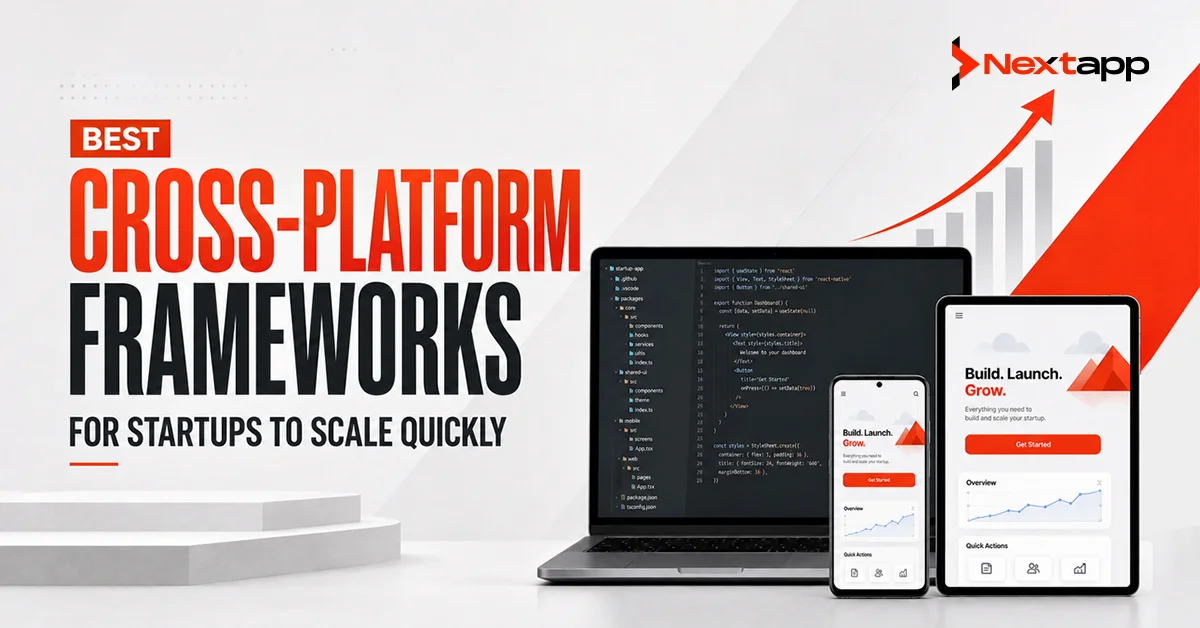
The best cross-platform frameworks for startups are Flutter, React Native, Kotlin Multiplatform, .NET MAUI, Ionic, and NativeScript. Each framework helps teams build apps for more than one platform, but the right choice depends on your product goals, budget, team skills, performance needs, timeline, and long-term scalability.
For most startups, Flutter and React Native are the strongest general-purpose choices because they offer fast development, strong communities, reusable code, and enough flexibility for MVPs and growing products. Kotlin Multiplatform is a strong option when a startup wants shared business logic with native app experiences. .NET MAUI works well for teams already using C# and Microsoft technologies. Ionic is useful for web-first startups that want to reuse web skills. NativeScript is a good fit when JavaScript or TypeScript teams want direct access to native APIs.
Choosing the right framework matters because the first version of your app is not only a launch tool. It becomes the foundation for future features, maintenance, user experience, and growth.
Why Startups Choose Cross-Platform App Development
Startups often choose cross-platform app development because they need to move quickly without building separate native apps for iOS and Android from scratch. A single shared codebase can reduce development time, simplify maintenance, and help teams launch faster.
For an early-stage startup, speed matters. Whether the focus is Android app development, iOS app development, or cross-platform app development, the goal is usually to validate the idea, test the market, collect feedback, and improve the product before spending heavily on separate native teams. Cross-platform app development supports this approach because one team can often create apps for both major mobile platforms.
Cost is another major reason. Native development usually requires separate iOS and Android developers. Cross-platform frameworks can reduce that need, especially for MVPs, prototypes, customer apps, booking apps, ecommerce apps, education apps, social apps, and internal business tools.
This does not mean cross-platform development is always cheaper or easier. Complex apps still need strong architecture, testing, native integrations, performance tuning, and experienced developers. The advantage is that startups can often begin with a smaller team and grow the product more efficiently.
What Makes a Cross-Platform Framework Good for Startups?
A good cross-platform framework for startups should support speed, flexibility, performance, maintainability, and scalability. It should help the team build quickly without creating technical debt that becomes expensive later.
The first factor is code reusability percentage. A framework that lets developers reuse more code across iOS and Android can reduce duplicate work. However, code reuse should not come at the cost of poor user experience.
The second factor is performance benchmarking. The app should feel smooth, responsive, and reliable. Startups cannot afford an app that feels slow or unstable during early user testing.
The third factor is the plugin ecosystem. Apps often need authentication, payment gateways, maps, camera access, push notifications, analytics, and third-party APIs. A strong plugin ecosystem can save development time.
The fourth factor is community support. A large community makes it easier to find solutions, hire developers, fix issues, and keep the project moving.
The fifth factor is long-term maintenance. The framework should be active, stable, and suitable for future growth.
Flutter for Fast MVPs and Visually Consistent Apps
Flutter is one of the best cross-platform frameworks for startups that want fast development and a highly consistent visual experience across platforms. It uses Dart and provides a rich widget-based UI system that helps teams create polished interfaces from a single codebase.
Flutter is especially useful for startups building consumer apps, marketplaces, booking apps, ecommerce apps, learning apps, wellness apps, finance dashboards, media apps, and MVPs with custom UI. It gives designers and developers more control over how the app looks and behaves.
One of Flutter’s biggest strengths is UI consistency. Since Flutter renders its own interface components, the app can look similar across iOS and Android. This is useful when a startup wants a strong brand experience from the first version.
Flutter also supports fast iteration. Developers can make changes and see results quickly during development, which helps startups test ideas and refine screens faster.
When Flutter Is a Strong Choice
Flutter is a strong choice when your startup wants one codebase, fast MVP development, custom UI, smooth animations, and good cross-platform consistency.
It is also a good option when your product needs a polished interface but does not require heavy platform-specific behavior in every screen. Many startup apps fit this category.
Flutter Limitations to Consider
Flutter may require developers to learn Dart if they do not already know it. This can affect hiring and onboarding if your team comes from a JavaScript or native background.
Some highly platform-specific features may still require native code. For most standard startup apps, this is manageable, but it should be considered during planning.
React Native for JavaScript Teams and Startup Speed
React Native is another top choice for startups because it allows teams to build native mobile apps using JavaScript or TypeScript with React. This makes it especially attractive for startups that already have web developers familiar with React.
React Native is widely used, has a large community, and offers a strong ecosystem of libraries. It is a practical choice for startups that want to move quickly, hire from a larger talent pool, and reuse some thinking between web and mobile development.
React Native works well for social apps, ecommerce apps, delivery apps, subscription apps, service apps, communication tools, productivity apps, and MVPs that need a native feel with fast development.
The framework also allows native modules when needed. This means a team can use JavaScript for most of the app while writing native code for specific features that require deeper platform access.
When React Native Is a Strong Choice
React Native is a strong choice when your team already knows React, JavaScript, or TypeScript. It is also useful when your startup needs faster hiring options and wants access to a large developer ecosystem.
It works well for apps with standard mobile interactions, API-based features, user accounts, dashboards, notifications, forms, and ecommerce flows.
React Native Limitations to Consider
React Native can require native development knowledge for complex features, performance-heavy screens, or advanced integrations. Some dependencies may also need maintenance as the ecosystem changes.
For startups, this means the team should not treat React Native as a no-code shortcut. It still requires strong engineering decisions.
Kotlin Multiplatform for Shared Logic and Native Experiences
Kotlin Multiplatform, also called KMP, is a strong option for startups that want to share business logic across platforms while keeping native UI where needed. Instead of forcing one UI layer across iOS and Android, KMP allows teams to share parts such as data handling, networking, validation, business rules, and domain logic.
This approach is useful for startups that care deeply about native user experience but still want to reduce duplicate development work. It is especially relevant for products with complex logic, fintech apps, healthcare apps, productivity tools, enterprise apps, and apps where long-term code quality matters.
KMP can be a smart choice when the Android team already uses Kotlin. It allows the team to extend shared logic to iOS while still giving iOS developers control over native interfaces.
When Kotlin Multiplatform Is a Strong Choice
Kotlin Multiplatform is a strong choice when the product has serious business logic, long-term scalability needs, and a desire for native UI quality.
It is also useful when a startup does not want a fully shared UI framework but still wants to reduce duplication between iOS and Android.
Kotlin Multiplatform Limitations to Consider
KMP may require stronger technical planning than Flutter or React Native. It can involve coordination between Android, iOS, and shared code layers.
For a very simple MVP, KMP may be more complex than necessary. For a serious product with long-term platform goals, it can be a strong architectural choice.
.NET MAUI for C# and Microsoft-Based Teams
.NET MAUI is a cross-platform framework that allows developers to build apps using C# and XAML. It is especially useful for startups and businesses already invested in the Microsoft ecosystem.
If your team uses .NET, Azure, C#, enterprise systems, or Microsoft-based backend architecture, .NET MAUI can reduce context switching. It can support mobile and desktop app development from a shared codebase, which may be useful for internal tools, B2B platforms, enterprise dashboards, and productivity apps.
.NET MAUI is not always the first choice for consumer startup apps, but it can be a strong fit for business-focused products where the team already has C# experience.
When .NET MAUI Is a Strong Choice
.NET MAUI is a strong choice when your development team already knows C# and wants to build cross-platform apps within the .NET ecosystem.
It is also a practical option for enterprise startups, internal business tools, dashboards, and apps connected to Microsoft infrastructure.
.NET MAUI Limitations to Consider
Hiring can be more specialized compared with React Native or Flutter. The ecosystem may also feel more natural to teams already familiar with Microsoft tools.
For startups without a C# background, another framework may be easier to adopt.
Ionic for Web-First Startups
Ionic is a good option for startups that already have web development skills and want to build mobile apps using HTML, CSS, and JavaScript with frameworks like Angular, React, or Vue.
Ionic is especially useful for content apps, simple business apps, internal tools, customer portals, ecommerce interfaces, and apps where web and mobile experiences are closely connected. It can also work well when a startup wants to launch a progressive web app and mobile app with similar code.
Ionic often appeals to web-first teams because it uses familiar tools. This can reduce learning time and allow faster prototyping.
When Ionic Is a Strong Choice
Ionic is a strong choice when the startup has web developers and wants to reuse web skills for mobile development. It is also useful for apps that do not require heavy native performance.
For simple MVPs, customer-facing portals, and app-like web experiences, Ionic can be efficient.
Ionic Limitations to Consider
Ionic apps may not always feel as native as Flutter, React Native, or Kotlin-based approaches. Performance can also depend on how well the app is built and what features it includes.
For highly interactive consumer apps, advanced animations, or performance-heavy features, another framework may be a better fit.
NativeScript for JavaScript Apps With Native API Access
NativeScript allows developers to build native iOS and Android apps using JavaScript or TypeScript. It gives direct access to native platform APIs, which can be valuable when a team wants native functionality while using web-friendly languages.
NativeScript can be useful for teams with JavaScript experience that need access to platform features without fully switching to Swift, Kotlin, or Java. It can support Angular, Vue, and TypeScript workflows.
When NativeScript Is a Strong Choice
NativeScript is a strong choice when a startup has JavaScript or TypeScript developers and needs direct access to native APIs.
It can work well for teams that understand mobile development requirements and want more platform control than some hybrid approaches offer.
NativeScript Limitations to Consider
NativeScript has a smaller ecosystem than Flutter and React Native. This may affect hiring, plugin availability, and community support.
A startup should choose NativeScript only when the team understands its trade-offs and has a clear reason for using it.
Xamarin and Why Startups Should Be Careful
Xamarin was once a popular cross-platform mobile development framework for C# developers. However, Microsoft ended support for Xamarin in 2024 and now directs developers toward .NET MAUI.
For new startup apps, Xamarin is usually not the right choice. Existing Xamarin apps should consider migration planning. If a vendor recommends Xamarin for a new project, ask why and request a clear explanation.
Choosing an unsupported framework can create maintenance risks, hiring challenges, security concerns, and upgrade problems.
Flutter vs React Native for Startups
Flutter vs React Native is one of the most common comparisons in cross-platform app development. Both are strong choices, and both can support startup growth.
Flutter is often better when the startup wants highly consistent UI, custom visuals, and smooth interface control. React Native is often better when the startup already has React or JavaScript developers and wants easier hiring flexibility.
Flutter may require learning Dart, while React Native uses JavaScript or TypeScript. Flutter offers strong control over the visual layer, while React Native connects React concepts to native mobile development.
The right choice depends on the team. A startup with a strong React web team may move faster with React Native. A startup building a highly visual app from scratch may prefer Flutter.
Framework Performance and User Experience
Performance matters because users judge apps quickly. Slow loading, laggy screens, delayed taps, poor scrolling, and crashes can damage trust.
Flutter generally performs well for custom UI and animation-heavy experiences. React Native can perform well when built properly, but complex screens may require optimization. Kotlin Multiplatform can deliver excellent native experiences because teams can keep native UI. .NET MAUI can perform well for business apps when implemented carefully. Ionic is suitable for many standard apps but may not be ideal for heavy native performance needs. NativeScript can access native APIs but requires skilled development to maintain quality.
Startups should test performance early. Do not wait until launch to discover that the chosen framework struggles with the app’s core experience.
Code Reusability Percentage and Real Startup Value
Code reusability percentage is often used to sell cross-platform development, but startups should look at it carefully. Reusing code is valuable only when it does not weaken user experience, app quality, or long-term maintainability.
Some frameworks allow high code reuse across platforms. Others share only business logic or selected modules. Both approaches can be valid.
A high code reuse percentage can reduce cost and development time. However, some platform-specific work is normal. Push notifications, camera features, payments, permissions, widgets, and native integrations may require custom handling.
A realistic development plan should include both shared code and platform-specific work.
Plugin Ecosystem and Third-Party Integrations
Startups often need third-party integrations from the beginning. These may include Stripe, PayPal, Firebase, Google Maps, Apple Sign-In, social login, analytics, push notifications, chat, CRM tools, and marketing automation.
A strong plugin ecosystem can reduce development time. Flutter and React Native both have large ecosystems. Ionic also has strong integration options through web technologies and native runtime support. .NET MAUI and Kotlin Multiplatform can support many integrations, but the approach may require more platform-specific planning. NativeScript offers native API access but has a smaller ecosystem.
Before choosing a framework, list your required integrations. Then check how mature the available packages or SDKs are.
Learning Curve and Hiring Availability
A framework should match your team’s skills. If your developers already know React, React Native can be easier. If your team knows C# and .NET, .NET MAUI may feel natural. If your Android team uses Kotlin, Kotlin Multiplatform may be a strong fit. If your team wants a fast UI-focused framework and is open to Dart, Flutter can work well.
Hiring availability also matters. React Native and Flutter developers are generally easier to find than specialists in smaller ecosystems. However, the quality of developers matters more than the number of resumes.
Startups should avoid choosing a framework only because it is trending. Choose the framework your team can build, test, maintain, and scale.
MVP Suitability for Startup Launches
For MVPs, Flutter and React Native are often the safest choices because they balance speed, ecosystem strength, and product flexibility. Ionic can also be excellent for web-first MVPs or simpler apps. Kotlin Multiplatform is better when the MVP needs native experience and long-term shared logic. .NET MAUI is strong for Microsoft-based teams. NativeScript works when direct native API access and JavaScript skills are both priorities.
The MVP should be simple enough to launch but solid enough to learn from real users. A poor technical foundation can make future scaling expensive.
The best framework is the one that helps you launch quickly without blocking future growth.
Scalability for Growth
A startup framework should support more than the first version. As the app grows, you may need more features, more users, better performance, analytics, subscriptions, integrations, security, and backend improvements.
Scalability depends on architecture more than framework alone. A poorly built Flutter app will not scale well just because Flutter is strong. A well-built React Native app can scale effectively with the right engineering practices.
Startups should ask development teams how they will handle code structure, state management, API layers, testing, documentation, version control, monitoring, and future maintenance.
Best Framework by Startup Type
A consumer app with custom UI may benefit from Flutter. A startup with a React web team may benefit from React Native. A fintech or enterprise app with complex logic may benefit from Kotlin Multiplatform. A Microsoft-based B2B startup may benefit from .NET MAUI. A web-first product may benefit from Ionic. A JavaScript team needing native API access may consider NativeScript.
There is no universal answer. Framework choice should follow the product, not the trend.
Decision Criteria Before Choosing a Framework
Before choosing a cross-platform framework, answer these questions clearly.
What platforms do you need at launch? What features are essential for the MVP? Does the app need heavy animations, camera access, offline support, payments, maps, or real-time chat? What skills does your current team have? How quickly do you need to launch? What is your startup budget? How important is native look and feel? How much platform-specific customization do you expect? How will the app be maintained after launch?
These answers will usually point toward the right framework.
Final Recommendation
The best cross-platform frameworks for startups are not ranked by popularity alone. They should be judged by product fit.
Flutter is one of the strongest choices for visually polished MVPs and consistent cross-platform UI. React Native is excellent for startups with JavaScript or React teams. Kotlin Multiplatform is ideal when shared logic and native experience both matter. .NET MAUI is a strong choice for C# and Microsoft-based teams. Ionic is useful for web-first startups and simpler app experiences. NativeScript is suitable when JavaScript teams need direct native API access. Xamarin should generally be avoided for new projects because support has ended.
For most startups, Flutter or React Native will be the practical shortlist. From there, the final decision should depend on your team, app complexity, development speed, maintenance requirements, and long-term growth plan.
Frequently Asked Questions
What is the best cross-platform framework for startups?
Flutter and React Native are usually the best cross-platform frameworks for startups because they offer strong ecosystems, fast development, good community support, and practical MVP suitability. The best choice depends on your team skills and app requirements.
Is Flutter better than React Native for startups?
Flutter may be better for startups that need custom UI, smooth animations, and strong visual consistency. React Native may be better for startups with React or JavaScript teams and easier hiring needs.
Is cross-platform development cheaper than native development?
Cross-platform development can be cheaper because one team can often build for both iOS and Android. However, complex apps still need strong architecture, testing, native integrations, and maintenance.
Which framework is best for MVP development?
Flutter and React Native are often the best choices for MVP development. Ionic can work well for web-first MVPs, while Kotlin Multiplatform is useful for products that need shared logic with native experiences.
Should startups use Xamarin for new apps?
Startups should usually avoid Xamarin for new apps because official support has ended. Microsoft now recommends .NET MAUI for teams that want a modern C# cross-platform framework.
Is Kotlin Multiplatform good for startups?
Kotlin Multiplatform can be good for startups with complex business logic and long-term native app goals. It is especially useful when the team wants to share logic across platforms while keeping native UI.
How do I choose the right cross-platform framework?
Choose based on product goals, team skills, budget, MVP timeline, performance needs, plugin ecosystem, hiring availability, and long-term maintenance. The best framework is the one your team can build and scale confidently.