

Key Takeaways
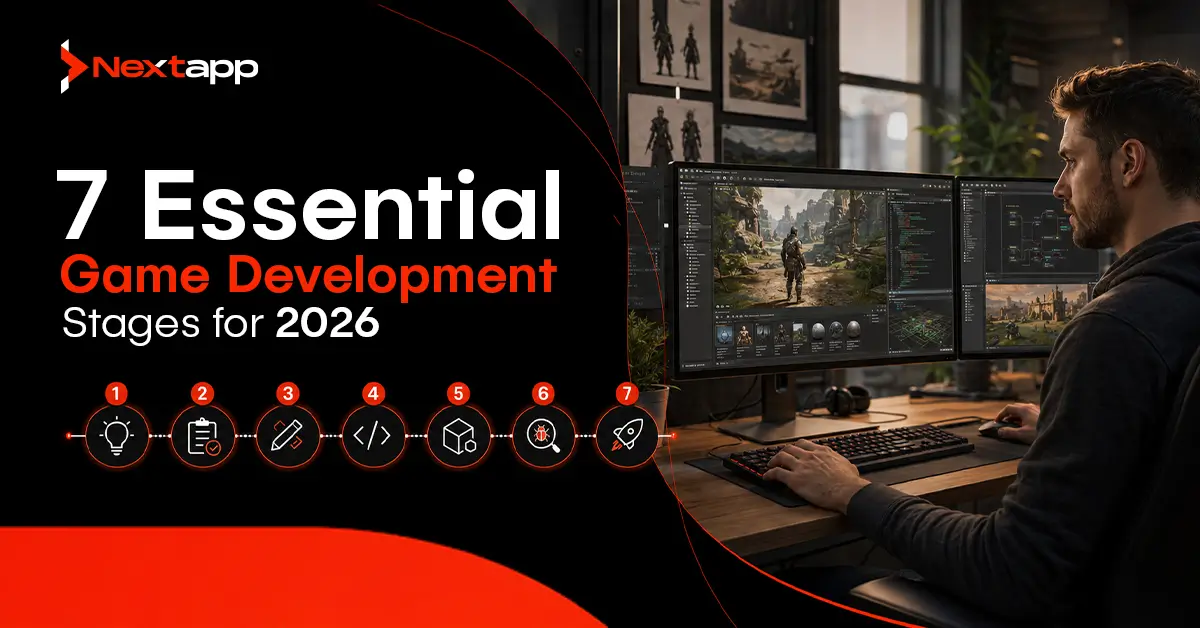
- The 7 game development stages are: Concept and Idea Generation, Pre-Production, Production, Testing and QA, Pre-Launch, Launch and Deployment, and Post-Launch Support.
- Early-stage testing reduces post-production bug-fixing effort by up to 50%, making structured QA non-negotiable.
- The Game Design Document (GDD) created in Pre-Production is the single source of truth that every discipline references throughout the entire build.
- Production consumes 60 to 80% of the total project budget and timeline across all game development stages.
- In 2026, Post-Launch Support is not optional. Live-service operations, content updates, and player retention campaigns are built into production planning from day one.
- Monetization models must be defined in Pre-Production, not after launch. Designing mobile game monetization systems into the game loop from the start determines long-term revenue performance.
- Understanding every stage helps developers, studios, and founders budget accurately, avoid scope creep, and ship games that compete.
Introduction
Every game that reaches a player goes through the same fundamental journey. The path from concept to playable product has a structure, and that structure is what separates games that ship on time from those that collapse mid-production. Understanding the game development stages is not just useful for developers. It is essential for anyone who is planning to build, fund, or partner on a game project in 2026.
The global gaming market is projected to reach $386.04 billion in 2026, growing at a CAGR of 12.5%. Mobile gaming alone generates over $126.1 billion annually, with 3.58 billion players worldwide. At this scale, the industry has long moved past the era of informal development. Professional production requires a disciplined pipeline, one where each stage has clear deliverables, team responsibilities, and success criteria.
This guide covers all 7 game development stages in full detail, explaining what happens at each phase, which roles are involved, what tools are used, and what mistakes cause projects to stall or fail. Whether you are an indie developer, a startup founder, or evaluating a mobile game development company, this is the complete roadmap.
Stage 1: Concept and Idea Generation
Every game begins with an idea, but not every idea becomes a game. The Concept and Idea Generation stage is where raw inspiration gets tested against commercial reality. This is the validation phase, where the team answers one critical question: Is this game worth building?
Concept validation covers four areas. First, market research identifies the target audience, competing titles, trending genres, and gaps in the current app store landscape. Second, the core gameplay mechanic is defined. What does the player do? What makes it compelling? Third, platform selection is made, such as mobile iOS and Android, PC, console, or cross-platform. Fourth, a high-level monetization direction is established, for example, whether the game will use in-app purchases, advertising, subscriptions, or a premium model.
The output of this stage is a High Concept Document: a one to two-page brief describing the game idea, its genre, target audience, platform, estimated scope, and preliminary revenue model. This document determines whether the project moves forward into Pre-Production or gets shelved.
Concept quality is the single strongest predictor of commercial success. Games with a clear, differentiated concept validated against real market data outperform those that began with vague or derivative ideas, regardless of how well they were executed technically.
Stage 2: Pre-Production
Pre-Production transforms the validated concept into a fully documented, technically planned project. This stage is often called the foundation stage because everything built in Production depends on decisions made here. Strong Pre-Production prevents the two most expensive problems in game development: scope creep and mid-project redesign.
The primary output of Pre-Production is the Game Design Document (GDD). The GDD is the single source of truth for the entire project. It defines gameplay mechanics and rules, progression systems and reward loops, UI and UX structure, art direction and visual style, narrative and dialogue outlines, monetization system architecture, and technical requirements and platform specifications.
Beyond the GDD, Pre-Production produces three critical additional outputs. First, concept art: visual mood boards and early character and environment sketches that lock the game’s aesthetic direction. Second, a prototype or vertical slice, which is a rough, functional build of the game’s core mechanic used to test whether the gameplay is actually fun before full production begins. Third, a production schedule with defined milestones, team assignments, budgets, and risk assessments.
Understanding what is game development at this stage means is understanding that Pre-Production is where mobile game monetization models must be finalized. Revenue systems built into the design from the start perform significantly better than those retrofitted after launch. Teams that rush through Pre-Production consistently face scope creep, technical debt, and expensive redesigns during Production.
Stage 3: Production
Production is the longest and most resource-intensive of all game development stages. This is where the game is actually built. Every discipline operates in parallel: programmers write systems, artists create assets, sound designers produce audio, level designers build environments, and writers produce dialogue. Production typically consumes 60 to 80% of the total project budget and timeline.
Production is structured around milestones. The first milestone is First Playable: a basic, playable version of the core loop with placeholder assets. First Playable proves that the game’s fundamental mechanics function as designed.
The second milestone is Pre-Alpha: most content exists in some form. The game is playable across most or all of its intended scope, though assets and systems remain incomplete.
The third milestone is Alpha: the Feature Complete build. Every major system and mechanic is implemented. The game is playable from start to finish. Internal testing begins in earnest.
Professional Production in 2026 uses Agile development workflows organized into sprints of two to four weeks. Each sprint produces a testable build with defined deliverables. Agile allows teams to adapt quickly to design changes, technical discoveries, and platform requirements without losing momentum.
Key technical decisions during Production include game engine configuration, backend architecture for online features, server infrastructure planning, and cross-platform deployment strategy. Studios working with a mobile game development company typically have these systems handled by dedicated technical leads who architect solutions that scale from soft launch through peak player volume.
Stage 4: Testing and QA
Testing and QA runs across the entire production lifecycle, not only at the end. Industry data shows that early-stage testing reduces post-production bug-fixing effort by up to 50%. Treating testing as a standalone final phase is one of the most common and costly mistakes in game production.
A professional QA program covers six testing types. Functional testing verifies that every feature and mechanic works as specified in the GDD. Performance testing validates frame rates, load times, memory usage, and battery consumption across all target devices. Compatibility testing ensures the game runs correctly on iOS 17 and 18, Android 13, 14, and 15, and across flagship and mid-range hardware. Regression testing confirms that new builds do not reintroduce previously fixed bugs. Usability testing, also called playtesting, measures how intuitive controls, tutorials, and UI elements are for real players. Security testing identifies vulnerabilities in backend systems, payment flows, and user data handling.
The testing environment progresses through three formal stages.
Alpha Testing is internal only. QA engineers play the feature-complete build systematically to identify bugs, balance issues, and design problems.
Beta Testing opens the game to a limited external audience, either a closed beta with invited players or an open beta with public access. Beta surfaces real-world feedback, device-specific issues, and server stability data under realistic load.
Gold Master is the final, approved build. This is the version submitted to the App Store and Google Play for certification review.
In 2026, AI-powered testing tools automate regression testing and performance benchmarking across device matrices, significantly reducing manual QA hours for compatibility validation. Human testers remain essential for gameplay balance, narrative coherence, and user experience evaluation.
Stage 5: Pre-Launch
Pre-Launch is the bridge between a certified game and a live one. Many developers handle this stage informally, but studios that achieve strong launch results treat Pre-Launch as a full production phase with its own team, budget, and deliverables.
Pre-Launch activities cover six areas. App Store Optimization (ASO) prepares the game’s store listing: title, icon design, screenshots, promotional video, keyword strategy, and description copy. Soft Launch deploys the game in a limited geographic market to gather real player data on retention, monetization performance, and technical stability before global release. Community Building establishes social media presence, Discord servers, and content creator partnerships in the weeks before launch. Press and Media Outreach pitches the game to gaming journalists, review outlets, and influencer networks. Paid UA Preparation sets up user acquisition campaigns on Meta, Google, TikTok, and ironSource to activate on launch day. Platform Certification submits the Gold Master build to Apple and Google for review, a process that takes three to seven business days and must be planned into the schedule.
Understanding how to advertise your mobile games starts here. The Pre-Launch stage is where the marketing narrative, creative assets, and paid acquisition strategy are finalized. Studios that delay marketing planning to this stage are already behind. Studios that begin building community and press relationships in Pre-Production are significantly better positioned.
Stage 6: Launch and Deployment
Launch Day is the moment the game becomes publicly available. It is also one of the highest-risk operational moments in the entire production lifecycle. Server infrastructure, monitoring systems, and customer support all face their first real-world stress test simultaneously.
A professional Launch and Deployment process covers six critical areas. Real-time server monitoring tracks player load, latency, and error rates from the first minute of availability. Crash reporting tools like Firebase Crashlytics or Sentry surface critical bugs discovered by real players that QA did not catch. User acquisition campaigns activate simultaneously with launch to drive initial install volume and App Store ranking signals. Community management teams monitor player feedback on social channels, review pages, and forums in real time. Hotfix deployment protocols allow engineers to push critical bug fixes within hours without full store resubmission for backend issues. Performance analytics track day-one metrics, including DAU (daily active users), session length, retention rate, and ARPU (average revenue per user).
The first 72 hours after launch determine initial App Store algorithmic ranking. High install velocity, strong ratings, and low crash rates signal quality to both the App Store and Google Play algorithms, improving organic visibility. This is why mobile game development services teams plan launch-day UA spend and community activation in advance rather than reacting after the game goes live.
Stage 7: Post-Launch Support
Post-Launch Support is where the majority of a game’s lifetime revenue is generated. In 2026, the industry will have fully shifted to live-service models for any game designed to retain players beyond their first week. Post-Launch is not a cleanup. It is an ongoing production operation.
Post-Launch operations cover five ongoing workstreams. Content Updates deliver new levels, characters, events, and features on a regular cadence, typically every two to six weeks, depending on game type. Live Events create seasonal in-game moments tied to holidays, anniversaries, or community milestones that spike engagement and generate revenue spikes. Balance and Performance Patches address gameplay issues identified from player data, fixing overtuned difficulty, broken mechanics, and performance regressions. Platform Compatibility Updates keep the game functional as iOS and Android operating system versions evolve. Player Retention Campaigns use push notifications, re-engagement ads, and win-back offers to recover churned players and extend lifetime value.
The most successful live-service games plan their first 12 to 18 months of Post-Launch content before the game ships. This requires designing content systems during Production to support modular expansion, rather than retrofitted DLC.
For developers focused on mobile game monetization statistics, Post-Launch data is where revenue optimization happens. A/B testing monetization prompts, pricing tiers, and seasonal offer structures in live builds generates real revenue intelligence that no amount of pre-launch modeling can replicate. Studios that use this data to iterate on mobile game monetization trends consistently outperform those that set monetization systems once and never revisit them.
How the 7 Stages Connect: The Full Production Timeline
The 7 game development stages do not operate as strictly sequential phases. Testing overlaps with Production from the first build. Pre-Launch activities begin while QA is still running. Post-Launch content is designed during Production. Understanding how these stages interact is as important as understanding what each one contains.
For a mid-tier mobile game with a $300,000 to $500,000 budget, a realistic production timeline looks like this: Concept and Idea Generation takes 2 to 4 weeks. Pre-Production takes 6 to 12 weeks. Production takes 24 to 40 weeks. Testing and QA runs continuously from week 8 through launch. Pre-Launch takes 6 to 8 weeks, overlapping with the final QA phase. Launch spans one to two weeks of active deployment operations. Post-Launch Support runs indefinitely, with the first content update typically shipping 4 to 6 weeks after launch.
For anyone planning to understand mobile game development cost accurately, mapping budget allocation to these stages reveals where money actually goes. Pre-Production and Concept together account for 8 to 12% of the total budget. Production accounts for 60 to 75%. Testing and QA accounts for 10 to 15%. Pre-Launch and Launch account for 5 to 10% of the development budget, with marketing and UA budgeted separately.
Common Mistakes at Each Game Development Stage
Concept: Skipping Market Research
Building on an unvalidated idea is the most expensive mistake in game development. Market research at the concept stage costs almost nothing. Rebuilding a game whose core concept does not resonate with players costs everything.
Pre-Production: Producing an Incomplete GDD
A GDD that leaves mechanics, monetization systems, or technical architecture undefined causes mid-production confusion and expensive redesigns. Every ambiguity in Pre-Production becomes a budget overrun in Production.
Production: Ignoring Scope Creep
Adding features mid-production without removing others breaks schedules and budgets. Disciplined change management and a locked feature list protect timelines.
Testing and QA: Treating QA as a Final Phase
Games that only enter formal QA after Production is complete accumulate months of unfound bugs. Continuous testing from First Playable forward is the professional standard.
Pre-Launch: Delaying Marketing
Starting ad revenue in mobile gaming campaigns and community building on launch day instead of during Pre-Launch results in weak launch velocity and poor App Store ranking signals.
Launch: Under-Provisioning Server Infrastructure
Server failures on launch day permanently damage player trust and review scores. Stress-testing backend infrastructure at 3x expected launch load is the minimum standard for any online game.
Post-Launch: Treating Launch as the Finish Line
Games that receive no content updates after launch lose players within 30 days. In 2026, a game without a Post-Launch content plan is a game without a revenue plan.
Conclusion
Mastering the 7 game development stages is the difference between a project that ships on time, on budget, and with commercial traction, and one that runs out of runway mid-Production. Every stage matters. Concept quality determines whether the idea is worth building. Pre-Production quality determines whether the build stays on track. Production quality determines what players actually experience. Testing quality determines how polished that experience is. Pre-Launch and Launch quality determine whether the game reaches its audience. Post-Launch quality determines whether it survives and grows.
Understanding these stages also connects directly to business decisions. It informs mobile game development cost estimates, mobile game monetization alternatives without ad design decisions, best mobile game monetization for revenue strategy choices, and the full scope of mobile game development services needed to execute each phase professionally.
If you are ready to take your game from concept to launch with expert guidance across every stage, NextApp Inc. delivers full-cycle mobile game development services from initial concept through live-service operations. Contact us to discuss your project today.
Frequently Asked Questions (FAQs)
What are the 7 game development stages?
The 7 game development stages are: Concept and Idea Generation, Pre-Production, Production, Testing and QA, Pre-Launch, Launch and Deployment, and Post-Launch Support. Each stage has distinct deliverables, team responsibilities, and success criteria.
Which game development stage takes the longest?
Production is the longest stage, typically consuming 60 to 75% of total development time. For a standard mid-tier mobile game, Production runs 24 to 40 weeks.
What is a Game Design Document (GDD) and when is it created?
A GDD is the complete project blueprint created during Pre-Production. It defines gameplay mechanics, art direction, progression systems, monetization architecture, and technical requirements. The GDD serves as the single source of truth for every discipline throughout the entire build.
When should monetization be designed into a game?
Monetization must be designed during Pre-Production, not after launch. The most profitable mobile game monetization strategy depends on designing revenue systems into the core gameplay loop from the start. Games that retrofit monetization after launch consistently underperform those that build it in from the beginning.
What happens during Post-Launch Support?
Post-Launch Support covers content updates, live events, performance patches, platform compatibility updates, and player retention campaigns. For games using mobile app monetization platforms, Post-Launch is where real-world revenue data enables monetization optimization through A/B testing and seasonal offer structures.
Do I need a game development company to manage all these stages?
Not necessarily. Indie developers can manage all stages independently for smaller projects. For mid-to-large scale commercial releases, working with a mobile game development company provides integrated production management, specialized disciplines, and proven workflows across all stages, reducing timeline risk and quality variance.