

Key Takeaways
- Knowing how to choose a mobile app development company starts with defining your project scope, platform requirements, and budget before you contact a single vendor.
- A company’s portfolio and industry-specific case studies are stronger proof of capability than any sales pitch or claimed client list.
- Technical expertise across iOS, Android, Flutter, and React Native, combined with post-launch support, separates serious development partners from project-close shops.
- Client reviews on verified platforms like Clutch and GoodFirms carry more weight than testimonials on a company’s own website.
- Development methodology matters as much as technical skill: Agile teams with milestone reviews and transparent communication deliver better outcomes than black-box development models.
- Pricing model alignment is critical. Fixed-price contracts suit stable scopes. Time and Materials contracts suit evolving requirements. Dedicated team models suit sustained long-term builds.
- Post-launch support, security standards, and IP ownership terms in the contract determine your long-term risk level as much as the initial development quality.
Introduction
The single most consequential decision in any mobile app project is not which features to build first or which platform to target. It is how to choose a mobile web app development company to partner with. The right development partner turns a well-defined idea into a live, working product. The wrong one turns a reasonable budget into a cautionary story.
The scale of the decision reflects the scale of the market. The global mobile app industry is on track to reach $988.5 billion by 2035. Over 257 billion apps are downloaded annually. Every product competing in this market was built by a team whose selection process either accelerated or undermined everything that followed. Understanding how to choose an app development company is the skill that protects your investment before a single line of code is written.
This guide covers 7 essential criteria that determine whether a development company will serve your project or complicate it. Each tip connects directly to the variables that consistently separate successful app launches from expensive failures in 2026.
Tip 1: Define Your Project Before You Contact Anyone
The clearest sign that a business is not ready to choose a development partner is approaching vendors without a defined project brief. Every qualified mobile app development company will ask the same questions at the outset: What problem does your app solve? Who is it for? What platform does it target? What is your budget and timeline? Businesses that answer these questions before the first vendor call spend less time in discovery, receive more accurate proposals, and make better comparative decisions.
Your pre-contact definition should cover four elements. First, the problem statement: one sentence describing the user's need for the app addresses. Second, the core feature list: the minimum set of capabilities the app must have at launch. Third, the platform target: iOS app development only, Android app development only, or cross-platform app development. Fourth, the budget range: a realistic estimate that accounts for development, design, testing, and the first year of post-launch maintenance.
Businesses that arrive at the vendor selection process with this definition in place receive proposals that address their actual project rather than generic service packages. They also disqualify vendors who cannot address their specific requirements quickly, which is itself a quality signal. Defining your project also helps you evaluate mobile app development cost estimates more accurately since vague briefs produce vague quotes that carry significant hidden cost risk.
Tip 2: Evaluate the Portfolio with Industry-Specific Filters
Portfolio review is the most commonly cited step in the process of how to choose a mobile app development company, and the most commonly done incorrectly. Most buyers look at the visual design quality of portfolio apps. The right question is not whether the apps look good but whether the company has built apps with the technical requirements your project needs.
Apply three filters to every portfolio you review. First, industry relevance: has the company-built apps in your specific sector? A company that has built healthcare apps understands HIPAA compliance architecture. A company with fintech case studies understands PCI-DSS payment flow requirements. Industry experience reduces both the learning curve and the compliance risk. Second, feature complexity: does the portfolio include apps with the specific functionality your product requires? Real-time tracking, in-app purchases, third-party API integrations, multiplayer functionality, and AI features all require specific engineering experience that does not transfer from simpler projects automatically. Third, outcome data: does the company share metrics about the apps they built? Download numbers, user retention rates, and revenue performance data confirm that the portfolio apps succeeded in the market, not just in the build phase.
Verified case studies with client names, project outcomes, and specific technical challenges addressed carry more evidential weight than screenshot galleries. When a company shows you a case study that describes the problem, the solution architecture, and the measurable result, you are seeing the kind of transparent communication that predicts project experience accurately.
Tip 3: Assess Technical Expertise and Platform Specialization
Technical expertise assessment is where the process of how to choose a mobile app development company moves beyond surface evaluation into substantive capability verification. The technology choices a development company makes determine the performance, scalability, security, and long-term maintainability of your product.
Platform specialization is the first technical question to address. If your project targets iOS, confirm that the company’s team includes Swift developers with App Store submission experience and familiarity with Apple Human Interface Guidelines. If your project targets Android, confirm Kotlin expertise and experience with the Google Play certification requirements. For cross-platform builds, confirm whether the company works primarily in Flutter (Dart), React Native (JavaScript/TypeScript), or Kotlin Multiplatform, and ask for examples of production apps built with each framework.
Beyond platform specialization, assess three additional technical dimensions. Backend architecture experience covers the server-side systems that power real-time features, user authentication, data storage, and API integrations. UI/UX design capability determines whether the company can produce interfaces that retain users past the first session, as 88% of users do not return after a single bad experience. Quality assurance practices determine the bug density of the delivered product and the reliability of its performance across the device matrix.
In 2026, leading mobile app development companies will integrate AI-assisted development tools including GitHub Copilot and Cursor, into their engineering workflows, which reduces build time by 20 to 30% without compromising code quality when implemented with proper review protocols. Ask any prospective partner how they incorporate AI tooling and how AI-generated code is reviewed before it reaches production.
Tip 4: Verify Client Reviews on Independent Platforms
Client reviews are the highest-signal external validation available when evaluating how to choose a mobile app development company. The critical distinction is between reviews on the company’s own website and reviews on independent verification platforms. Clutch, GoodFirms, and AppFutura all verify reviewer identity and project details before publishing reviews. A company with strong ratings across 20 or more verified projects on Clutch presents a level of social proof that no self-published testimonial can replicate.
When reading verified reviews, look beyond the overall rating to the sub-category scores. Clutch separates ratings into quality, cost value, schedule adherence, and willingness to refer. A company scoring 4.9 on quality but 3.8 on schedule adherence signals a specific operational risk: they build well but deliver late. A company scoring high on willingness to refer tells you that clients thought the relationship was worth recommending, which is the strongest validation signal available.
Direct reference calls are more valuable than reading reviews. A qualified development partner provides client references you can contact directly. Prepare five questions before each reference call: Did the company deliver on time? How did they handle scope changes? How was communication during the project? What would you do differently? Would you hire them again? The answers to these five questions reveal the project experience more accurately than any written review.
Tip 5: Evaluate Communication Process and Development Methodology
Communication failure is the most frequently cited cause of mobile app development project failure, ahead of technical problems and budget overruns. The development methodology a company uses determines how visible your project progress is, how responsive they are to change requests, and how quickly problems are identified and resolved.
Agile development methodology is the current professional standard for mobile app projects. Agile organizes work into sprints of two to four weeks, each delivering testable functionality against a defined milestone. Sprint reviews give clients the opportunity to see working software regularly, request adjustments before they become expensive, and track budget consumption against delivered output. Companies that cannot describe their Agile sprint process in concrete terms during a sales call are unlikely to implement it effectively during the project.
Communication standards to verify before signing any contract cover four areas. Meeting cadence: how often does the team hold client reviews? Weekly sprint demos are the standard for active development phases. Progress reporting: Does the team use project management tools like Jira, Linear, or Notion that give clients real-time visibility into task status without requiring a scheduled call? Time zone coverage: if the company operates offshore, how many hours of overlap exist between their working hours and yours? For projects with evolving requirements, fewer than four hours of daily overlap creates coordination delays that compound over a six-month build. Escalation path: Who do you contact if a problem is not being resolved at the project manager level?
Tip 6: Understand the Pricing Model and What It Includes
Understanding pricing structure is essential to the process of how to choose a mobile app development company because the pricing model you agree to determines your budget risk as much as the headline price. Three pricing models dominate mobile app development engagements in 2026.
Fixed-price contracts set a defined cost for a defined scope. They work when requirements are stable, fully documented, and unlikely to change during the build. The risk of fixed-price contracts is that scope changes mid-project trigger change orders that inflate the final cost above the original quote. Businesses that treat a fixed-price quote as a budget ceiling while continuing to evolve their requirements consistently experience budget overruns despite the fixed-price framing.
Time and Materials contracts bill actual hours worked at an agreed hourly rate. They provide maximum flexibility for requirement evolution but transfer budget control risk to the client. Businesses using Time and Materials contracts must implement milestone-based spending reviews to avoid budget drift. This model works best for startups with evolving product vision and for complex projects where full scope cannot be accurately defined at the outset.
Dedicated team models provide a retained team of specified roles billed at a monthly rate. They are best suited for sustained product builds, post-launch live service operations, and businesses that need ongoing development capacity beyond the initial launch. Dedicated team arrangements also transfer more institutional product knowledge to the client organization because the team builds deep familiarity with the codebase over an extended engagement.
Hidden costs that are not covered by headline quotes include: third-party API integration fees, App Store and Google Play developer account fees, backend server and cloud infrastructure costs, post-launch maintenance for OS compatibility updates, and the cost of fixing bugs discovered after the warranty period. Request an itemized cost breakdown that addresses each of these categories before signing any agreement.
Tip 7: Confirm Post-Launch Support, Security Standards, and IP Ownership
The final and most frequently overlooked dimension of how to choose a mobile app development company covers three contractual elements that determine your long-term risk exposure after the development relationship ends.
Post-launch support defines what the company will do, and what it will not do, after your app is live. Industry standard post-launch support covers a warranty period of 30 to 90 days during which defects resulting from the development work are fixed at no additional charge. Beyond the warranty period, ongoing support, OS compatibility updates, and feature additions are billed separately. Companies that offer no defined post-launch support period transfer all post-deployment risk to the client immediately upon handover. This creates a situation where critical bugs discovered one week after launch are treated as new billable work.
Security standards are non-negotiable for apps that handle user data, payment information, or personal health information. At minimum, confirm that the development company implements data encryption at rest and in transit, secure authentication protocols, and penetration testing as part of the QA process. For healthcare apps requiring HIPAA compliance, financial apps requiring PCI-DSS standards, and European-market apps requiring GDPR-compliant data handling, confirm that the company has specific prior experience building within those regulatory frameworks before signing.
IP ownership must be explicitly stated in the contract. The contract should confirm that upon receipt of full payment, the client receives full ownership of all custom code, design assets, and deliverables produced during the engagement. Without explicit IP assignment language, some jurisdictions create ambiguity about who owns the code when the development relationship ends. Verify that the IP assignment clause is clear, unambiguous, and covers all deliverables including third-party component licenses incorporated in the product.
Bonus: How to Compare Multiple Vendors Systematically
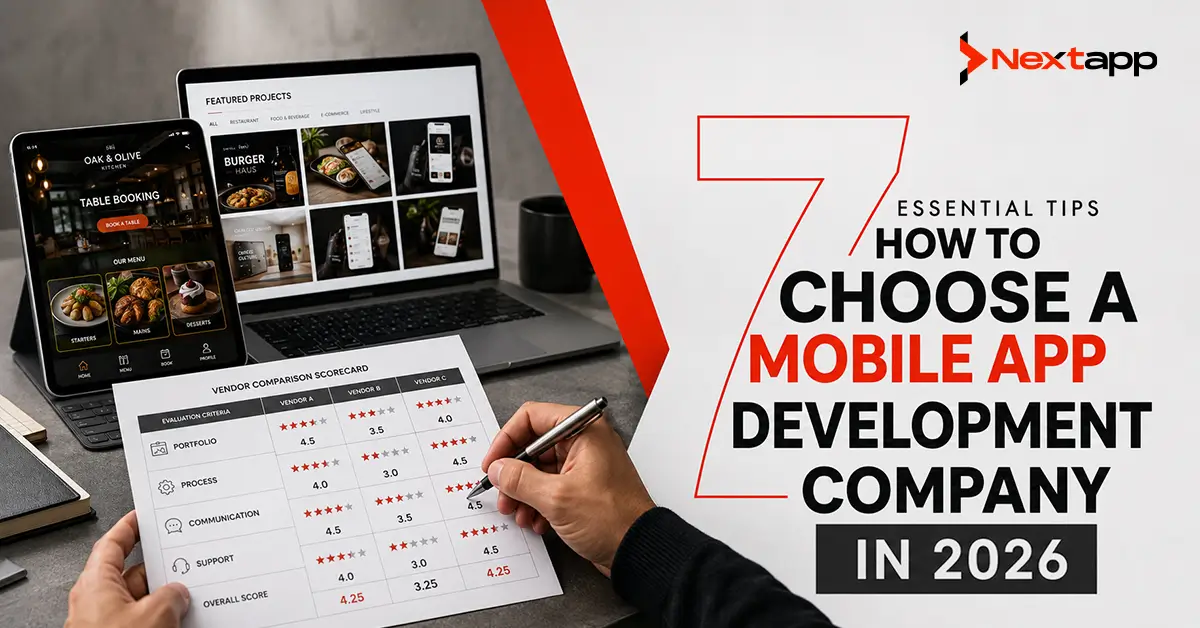
After applying the seven tips above to your shortlist, create a scoring rubric with six dimensions: technical expertise, portfolio relevance, client reviews, communication quality, pricing transparency, and post-launch support terms. Rate each vendor on a scale of one to five on each dimension. The vendor with the highest combined score is not automatically the right choice, but the scoring process forces explicit comparison of the factors that matter most and prevents selection based on presentation quality alone.
The relationship dimension matters alongside the data. A vendor who asks thoughtful questions about your business goals during the discovery call, pushes back on features they believe will not serve your users, and demonstrates genuine investment in the product succeeding in market is demonstrating the partnership mentality that sustains difficult projects through scope challenges and timeline pressure. This quality is harder to score but easy to recognize across multiple vendor interactions.
Conclusion
Understanding how to choose a mobile app development company is the foundational skill that determines whether a mobile app investment succeeds or fails. The seven tips in this guide cover the full evaluation spectrum: from pre-contact project definition and portfolio analysis through technical assessment, client verification, communication standards, pricing model selection, and contractual protection.
The best development partners are not always the largest or the most expensive. They are the companies that ask better questions than their competitors, deliver transparent communication throughout the project, and treat your product’s success in the market as their own responsibility rather than someone else’s problem after handover.
If you are ready to evaluate a development partner who applies all seven criteria to every engagement, Next Apps delivers full-cycle mobile app development services across iOS, Android, Flutter, React Native, game development, e-commerce, web platforms, and custom software. Contact our team to start the conversation.
Frequently Asked Questions (FAQs)
How do I choose between an offshore and a local mobile app development company?
Offshore development companies offer 50 to 70% cost savings versus North American or Western European rates. The trade-off is time zone overlap, communication frequency, and cultural alignment. For projects with stable, well-documented requirements, offshore development consistently delivers strong value. For projects with evolving requirements where daily real-time collaboration is critical, nearshore or hybrid models that combine offshore development with local product management perform better.
How much should a mobile app development company charge?
Professional mobile app development costs $15,000 to $500,000+ depending on complexity. North American agencies charge $100 to $250 per hour. Eastern European agencies charge $40 to $80 per hour. Indian agencies charge $15 to $50 per hour. The appropriate budget depends on feature scope, platform count, backend complexity, and post-launch maintenance requirements. Quotes below $15,000 for a commercially viable app with real functionality should be treated with scepticism.
How do I verify that a mobile app development company is legitimate?
Verify independently on Clutch or GoodFirms. Check company LinkedIn profiles for actual team members with verifiable employment history. Request three client references and contact them directly. Review the contract before signing for IP ownership clauses, payment schedule terms, and post-launch support definitions. Legitimate companies provide all of this information willingly.
Should I choose a company that specializes in iOS or Android specifically?
Platform specialization matters when your project has advanced platform-specific requirements. Native iOS development with Swift provides maximum hardware integration for AR, camera, and biometric features. Native Android development with Kotlin provides the broadest device coverage for global markets where Android dominates. For most commercial mobile app projects in 2026, a iOS app development company or android app development company with cross-platform experience in Flutter or React Native delivers the most cost-effective path to both platforms without sacrificing production quality.
What red flags should I watch for when choosing a mobile app development company?
Refuse any company that: provides a detailed quote without asking substantive questions about your requirements, cannot name the specific developers who will work on your project, has no verifiable client reviews on independent platforms, is unable to explain its QA testing process, includes no post-launch warranty period in its contract, or refuses to provide client references for prior projects comparable to yours.
How important is post-launch support when choosing a development company?
Post-launch support is critical. The first 90 days after launch generate the highest density of user-reported bugs, OS compatibility issues, and performance problems under real-world load. A company that offers no post-launch warranty period or ongoing support capability forces you to re-engage a new vendor for critical fixes at a moment when speed is essential and context transfer creates significant overhead.