

Key Takeaways
- Mobile game monetization is the system by which games convert player engagement into sustainable revenue. It must be designed during pre-production, not added post-launch.
- IAPs still account for over 50% of global mobile game revenue in 2026, led by mid-core and RPG genres with strong progression systems.
- Hybrid monetization combining IAP and rewarded advertising is the dominant revenue model across casual and mid-core games, accounting for over 60% of total revenue in these categories.
- ARPDAU (Average Revenue Per Daily Active User) is the North Star metric for mobile game monetization. It measures total revenue efficiency per active player per day, combining ad and IAP income.
- Battle passes convert 12 to 18% of active users, compared to traditional IAP conversion rates of 2 to 5%, making them one of the highest-performing recurring revenue formats in 2026.
- Subscriptions generate the most predictable revenue but require daily play loop justification. Games that cannot justify daily sessions should not lead with subscription models.
- Monetization design must prioritize fairness and perceived value. Pay-to-win mechanics and aggressive interstitial ads directly correlate with increased churn and negative review accumulation.
Introduction
Mobile game monetization is the discipline of converting player engagement into revenue without destroying the player experience that generated that engagement in the first place. In 2026, it is also the most consequential design decision any mobile game studio makes.
The global mobile gaming market generates over $126.1 billion annually. IAPs alone captured $107.3 billion in consumer spending. Yet the industry's average IAP conversion rate sits at just 2 to 5% of daily active users. That means 95 to 98% of players in most games never make a purchase. The gap between what mobile games could earn and what they actually earn is filled by the quality of the mobile game monetization strategy, system design, and execution.
This guide covers the five primary monetization models (IAP, Advertising, Subscriptions, Virtual Currency, and Freemium), the hybrid approaches that combine them, the metrics that measure success, and the 2026 trends shaping how studios build revenue systems. Every section connects monetization design to player experience, because the two are inseparable in practice.
What Is Mobile Game Monetization?
It refers to the strategies, models, and systems that generate revenue from a mobile game's player base. It encompasses every mechanism by which a game converts time spent playing into money: charging for downloads, selling virtual items, displaying advertisements, charging recurring subscription fees, or combining multiple methods.
Monetization decisions affect game design at every level. A game designed around rewarded advertising requires frequent natural session breaks for ad delivery. A game designed around IAP progression requires a currency economy that creates both desire and friction. A game designed around subscriptions requires content volume that justifies a recurring payment. The model must match the core loop, the genre, and the target audience. Getting this wrong in pre-production is expensive. Getting it right defines the game's revenue ceiling.
For context on how monetization fits within the broader production process, see the guides on what is game development and the game development stages which explain where monetization system design belongs in the production timeline.
Model 1: In-App Purchases (IAP)
In-app purchases remain the single largest revenue driver for mobile games in 2026. Despite all attention on advertising and subscription growth, IAPs account for over 50% of global mobile game revenue according to data.ai, concentrated in mid-core, RPG, and competitive multiplayer genres.
IAP products fall into three categories. Consumables are items purchased repeatedly: extra lives, energy refills, power-ups, and in-game currency. They drive repeat purchase behavior and are the most reliable revenue stream in games with progression-based friction. Non-consumables are one-time purchases: level packs, new characters, permanent upgrades, and ad removal. They reduce the purchase barrier for players who want a one-time commitment rather than ongoing spending. Cosmetics are visual customizations with no gameplay impact: character skins, animations, effects, and profile icons. They avoid pay-to-win criticism, convert enthusiastic players at high rates, and represent the dominant IAP category in multiplayer games.
IAP design best practices in 2026 center on three principles. First, offer products at multiple price points: $0.99, $2.99, $4.99, $9.99, and $19.99. Players choose what their budget allows. Price anchoring at higher tiers makes mid-tier options feel like value. Second, align IAP timing with player intent moments. A player who just failed a level for the third time has higher purchase intent than a player cruising through easy content. Monetization prompts that appear at friction points convert at 3 to 5x the rate of prompts appearing at random intervals. Third, use Starter Bundles for new players. A $0.99 or $1.99 bundle with 10x perceived value converts 20 to 40% of new players who would not purchase at standard pricing, establishing a first purchase that dramatically increases LTV.
Sensor Tower data shows bundled IAPs generate conversion rates 30 to 40% higher than standalone items. The key is aligning bundle composition with the stage of the player's journey: early bundles should accelerate the initial experience, late bundles should support endgame engagement.
For studios using a mobile game development company to build IAP systems, the technical integration requires Apple StoreKit (iOS), Google Play Billing (Android), and backend receipt validation to prevent fraud. These integrations must be built during production, not added post-launch.
Model 2: Advertising Integration
In-app advertising (IAA) monetizes the 95 to 98% of players who will never make a purchase. For free-to-play games with large player bases, advertising is often the primary revenue source.
Four ad formats dominate ad revenue in mobile gaming in 2026. Rewarded video is the highest-performing format: players voluntarily watch 15 to 30-second videos in exchange for in-game rewards. Opt-in completion rates exceed 95%. Players who engage with rewarded ads are 4x more likely to make subsequent in-app purchases, making rewarded video a conversion bridge as well as a revenue source. eCPMs for rewarded video in the US iOS reach $11 to $20. Interstitial ads appear at natural session breaks (between levels, after death, at menu transitions) and deliver strong impression volume without opt-in mechanics. eCPMs range from $4 to $10 in tier-1 markets. Banner ads provide low revenue per impression ($0.50 to $2 eCPM) but deliver consistent volume across long session durations. Playable ads allow a 30-second interactive demo, driving premium eCPMs ($10 to $25) and high advertiser conversion rates.
Ad frequency management is the critical variable that separates healthy ad monetization from player churn-inducing over-monetization. Showing ads too frequently decreases retention and lifetime value. The optimal balance is found by running A/B tests that monitor simultaneous changes in ARPDAU, Day 7 retention, and session length. The inflection point where ARPDAU growth begins to slow as retention drops is the maximum ad frequency the player base will tolerate.
For ad network selection and mediation setup, see the companion guide on mobile app monetization platforms which covers AdMob, AppLovin MAX, IronSource, Unity Ads, and Applovin mediation configuration in detail.
Model 3: Subscription Models
Subscriptions generate the most predictable and stable revenue of any mobile game monetization model. Monthly subscription rates in mobile games typically range from $2.99 to $9.99. Annual plans at $19.99 to $49.99 generate 3 to 4 months of free revenue upfront while locking in player retention.
Successful mobile game subscriptions in 2026 deliver four categories of ongoing value: exclusive content (story chapters, seasonal areas, premium cosmetics), recurring in-game currency (weekly or monthly currency allowances), gameplay advantages (energy recharge speed, ad removal, exclusive boosts), and access passes (battle pass equivalent with structured rewards over 30 days).
The subscription model works best for games with a daily play loop justification: something new happens every day that makes logging in valuable. Idle games, simulation games, daily puzzle games, and social casino games all support subscriptions effectively. Pure action games or puzzle games with finite content struggle to retain subscribers past 30 days.
Battle passes represent the most successful subscription-adjacent format in 2026. Battle passes convert 12 to 18% of active users per season, compared to 2 to 5% IAP conversion. They create a 30- to 90-day engagement commitment, driving daily session habits that increase both ad impressions and IAP conversion. Games like PUBG Mobile and Clash of Clans demonstrate that a well-designed battle pass can become the single highest-revenue SKU in the game's entire monetization portfolio.
Model 4: Virtual Currency Systems
Virtual currency systems create an abstraction layer between real money and in-game purchases. Players buy premium currency (Gems, Coins, Gold, Crystals) with real money, then spend that currency on in-game items. This abstraction serves three monetization functions: it reduces price-sensitivity by creating psychological distance from real-money spending, it enables bundle pricing that makes large purchases feel like value (1,000 Gems for $0.99 versus 10,000 Gems for $4.99), and it generates currency inventory that increases purchase frequency when players have unspent balance.
Designing a virtual currency economy requires balancing four variables. Earn rate: how fast players accumulate free currency through gameplay. Spend rate: how much content costs relative to the earn rate. Purchase conversion points: the friction levels where free currency runs out and purchase prompts trigger. Whale ceiling: the maximum amount a dedicated spender can invest before the economy caps out.
Well-designed virtual currency economies ensure that free players experience enough of the premium content to desire more, while paying players never feel the economy is designed to extract maximum spend regardless of value. Games that get this balance wrong develop pay-to-win reputations that increase uninstall rates and negative reviews, damaging both organic visibility and advertiser eCPMs simultaneously.
Model 5: Freemium Model
The freemium model is the structural foundation of modern mobile gaming. The game is free to download and play with a complete core experience, while premium content, currency, or features are available for purchase. Freemium is not a monetization model itself but the access structure that makes IAP, advertising, and subscriptions viable at scale.
Freemium success depends on three design decisions. First, the free experience must be genuinely compelling. Players who enjoy the core loop before encountering monetization prompts convert at 3 to 5x the rate of players who hit paywalls before they are emotionally invested in the game. Second, the premium layer must offer clear incremental value above the free experience. Cosmetics, time-saving items, and content expansions all meet this standard. Mandatory progression unlocks that block players from completing the core story do not. Third, the transition from free to paid must feel natural and optional, not coerced. Games where players feel forced to purchase to progress generate hostile reviews regardless of actual game quality.
Understanding mobile game monetization alternatives without ads starts here. Pure freemium with IAP-only monetization is viable for mid-core and core audiences who are willing to pay but deeply resistant to advertising interruptions. Games targeting this audience should consider foregoing ad integration entirely in favor of higher IAP price points and cosmetic bundles.
Hybrid Monetization: The 2026 Standard
Hybrid mobile game monetization combines IAP with rewarded advertising and often a battle pass or subscription layer. It is the dominant model among top-grossing mobile games in 2026. Sensor Tower data shows hybrid-monetized games consistently achieve higher ARPDAU and longer player lifecycles than single-revenue-stream games.
The Tri-Model Framework used by many top studios in 2026 layers three revenue streams for different player segments. Advertising monetizes the large casual player base through rewarded video and interstitials, generating revenue from players who never purchase. IAP captures spending from dedicated players and high-spending whales, generating the majority of total revenue from a small minority of players. A seasonal battle pass or subscription creates a loyal middle tier of committed players, generating predictable monthly recurring revenue.
The key implementation principle is phasing. Introduce rewarded ads first, from day one of gameplay. Add IAP starter bundles at day three to seven when players have an emotional investment in the game. Introduce the battle pass after the first content update, once the live-service cadence is established. Early IAP without earned engagement, or aggressive advertising before players are invested, creates monetization fatigue before loyalty is built.
For a detailed analysis of which hybrid model generates the highest returns by game genre, see the guide on the most profitable mobile game monetization strategy and best mobile game monetization for revenue for current genre-specific data.
ARPDAU: The Metric That Drives All Monetization Decisions
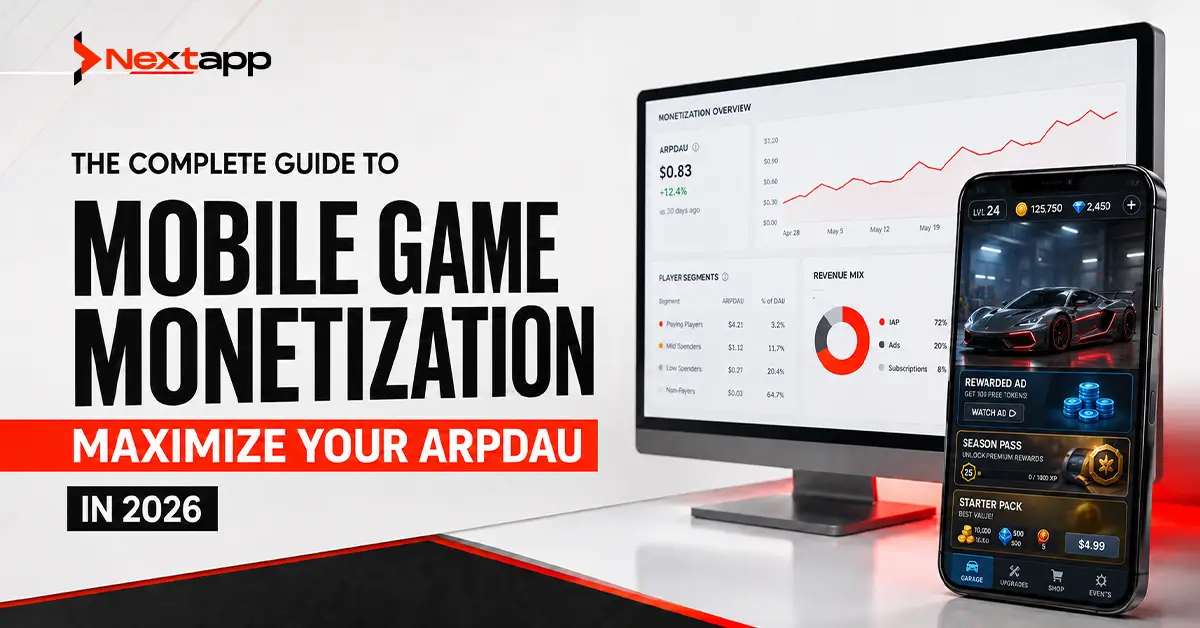
ARPDAU (Average Revenue Per Daily Active User) is the single most important metric in mobile game monetization. It measures how much revenue each active player generates per day, combining both ad revenue and IAP income.
ARPDAU benchmarks by genre in 2026: hyper-casual games achieve $0.04 to $0.06 ARPDAU, driven almost entirely by advertising. Casual puzzle games achieve $0.08 to $0.12 ARPDAU through hybrid IAP and ads. Mid-core strategy and RPG games achieve $0.15 to $0.30 ARPDAU with IAP-dominant models. Core competitive games achieve $0.30 to $0.80+ ARPDAU with IAP, battle pass, and subscription stacks.
The formula for improving ARPDAU covers four levers. Increasing ad frequency raises ARPDAU until retention begins declining. Optimizing IAP conversion through bundle design and intent-based offer timing increases the revenue per paying player. Improving retention extends the total number of days players remain active, compounding lifetime ARPDAU into higher LTV. Launching live events creates ARPDAU spikes that generate above-average daily revenue during event periods.
Understanding ARPDAU benchmarks also informs how to advertise your mobile games profitably. If your ARPDAU is $0.10 and your Day 30 retention is 15%, your 30-day LTV per acquired player is approximately $0.45. Any CPI below $0.45 is theoretically profitable, though in practice studios target CPI at 30 to 40% of 90-day LTV to build margin.
Monetization Pitfalls That Kill Revenue and Players
Six monetization mistakes consistently reduce both revenue and retention. Pay-to-win mechanics destroy competitive fairness and generate long-term negative reviews that permanently damage organic discovery. Interstitial ad overexposure (more than one interstitial per three minutes of play) directly correlates with increased Day 7 churn across genres. Opaque value propositions in IAP stores (players cannot tell what they are actually buying) reduce purchase conversion by 40 to 60%. Monetization systems launched at day one without player loyalty built first generate hostile first-impression reviews. Single-price point IAP stores with only $4.99 and $9.99 options miss the conversion opportunity of the 60% of players whose budget sits at $0.99 to $2.99. Live event monetization that gates event content entirely behind premium currency generates community backlash that can permanently damage game reputation.
Monetization Trends Shaping 2026
Four mobile game monetization trends are reshaping revenue architecture across the industry. First, hyper-personalized IAP offers: games use AI-driven player behavior analysis to surface custom bundles at individually optimized price points and timing, with early data showing 30 to 50% conversion lift over static store inventories. Second, web shop direct sales: studios selling premium currency and bundles through their own websites rather than in-app bypass Apple and Google's 30% commission (or 15% for smaller developers), materially improving gross margin. Third, subscription bundling: games participating in Apple Arcade, Netflix Games, and Xbox Game Pass access guarantee revenue without UA costs but sacrifice direct monetization control. Fourth, D2C community monetization: games selling merchandise, limited physical items, and creator collaborations directly to their most loyal community members without platform fees.
Tracking mobile game monetization statistics across competitors in your genre is the fastest way to identify which of these trends your player base is already primed to accept.
Conclusion
Mobile game monetization in 2026 is a disciplined system design challenge, not a feature you add at the end of production. The studios that generate sustainable revenue build monetization architecture into pre-production, align model choice with genre and audience, introduce revenue mechanisms in phases that respect player loyalty, and optimize continuously using ARPDAU and retention as guiding metrics.
The connection between ad revenue in mobile gaming, IAP design, subscription structure, and mobile game monetization alternatives without ads is not a choice between competing options. It is a layered system where each component serves a different player segment and a different stage of the player lifecycle.
For developers building their first monetized title and for studios scaling a live-service operation, working with an experienced mobile game development company ensures that monetization systems are designed correctly from the architecture level, not retrofitted. NextApp Inc. provides full-cycle mobile game development services including monetization architecture, live-ops strategy, and performance analytics. Contact us to build a revenue system that compounds over time.
Frequently Asked Questions (FAQs)
What is the best mobile game monetization model in 2026?
Hybrid monetization combining rewarded video ads with in-app purchases is the best-performing model for most casual and mid-core games. For core and competitive games with engaged audiences, IAP combined with a battle pass or subscription generates the highest ARPDAU.
How do I increase IAP conversion rates?
Use starter bundles with 5x to 10x perceived value at $0.99 to $1.99. Display purchase prompts at intent moments (post-failure, near progression threshold). Offer five to seven price points, not one or two. Ensure value is instantly clear without requiring math or reading comprehension.
Is advertising bad for player experience?
Not when implemented correctly. Rewarded video ads (opt-in) are preferred by 50% of gamers over paid and freemium models according to Business of Apps 2026 data. Forced interstitials shown at high frequency are the format that damages experience and retention.
What is ARPDAU and why does it matter?
ARPDAU is Average Revenue Per Daily Active User. It is the primary efficiency metric for mobile game monetization, measuring how effectively your monetization system converts active players into revenue each day. Benchmarks range from $0.04 for hyper-casual to $0.80+ for core games.
How do I choose between ads and IAP for my game?
Genre determines the primary model. Hyper-casual and casual games with large non-paying audiences prioritize ads. Mid-core and RPG games prioritize IAP with supplemental rewarded ads. Competitive multiplayer games prioritize IAP and battle passes. For a full breakdown by game type, see the guide on mobile game monetization models.
Where can I find monetization tools and platforms?
See the complete guide on mobile app monetization platforms for a current list of ad networks (AdMob, AppLovin MAX, Unity Ads, IronSource), IAP integration platforms (RevenueCat, Adapty), and analytics tools (GameAnalytics, Firebase, Sensor Tower) validated for 2026 production.