

Key Takeaways
- Understanding all mobile game monetization models before production starts is the single most impactful monetization decision a studio makes.
- 95% of mobile games on the market are free-to-play, with IAP as the primary revenue driver. Only 3.01% of Google Play and 4.9% of App Store games require upfront payment.
- The Hybrid Model combining IAP and rewarded advertising is now the dominant standard, generating the highest ARPDAU and longest player lifecycles across casual and mid-core genres.
- Subscription-based games convert 12 to 18% of active users, compared to the 2 to 5% IAP conversion rate seen in traditional freemium titles.
- Strategy games lead all genres with $17.5 billion in IAP revenue in 2024, followed by RPG at $16.8 billion, Puzzle at $12.2 billion, and Casino at $11.7 billion.
- Premium models work for niche, high-quality titles (Stardew Valley, Monument Valley) but face a shrinking addressable market as player expectations shift to free-to-play.
- Every model should be selected based on three variables: game genre, target audience behavior, and content update cadence.
Introduction
The decision about which mobile game monetization models to adopt is not a post-launch consideration. It is a foundational design choice that shapes how the game is built, how the economy is structured, and whether the business behind it survives long enough to grow. Studios that treat monetization as an afterthought consistently produce underperforming revenue regardless of game quality.
The global mobile gaming market surpassed $170 billion in revenue in 2024, and projections for 2026 put it at $386 billion when accounting for full gaming ecosystem spending. Within that market, multiple mobile game monetization models compete for developer adoption. Each carries different player experience implications, different revenue trajectories, and different genre suitability. Understanding all of them and how they can be combined is the prerequisite for making the right choice for your specific title.
This guide covers all five primary mobile game monetization models in depth: Freemium, Premium, Hybrid, Subscription-Based, and Pay-to-Play. For each model, you will find how it works, which genres it suits, what the revenue benchmarks look like, the advantages and limitations, and the conditions under which it outperforms alternatives. Every section connects to the broader production and strategy decisions covered in companion guides on mobile game monetization, ad revenue in mobile gaming, and the most profitable mobile game monetization strategy.
Model 1: Freemium Model
The freemium model is the structural foundation of modern mobile gaming. The game is free to download and play, with a complete or near-complete core experience available at no cost. Revenue is generated through optional in-app purchases, advertising, or both. The term combines “free” and “premium” to describe this access-plus-upsell architecture.
According to Business of Apps data, 79% of mobile games monetize with in-app purchases within a freemium structure. The model’s dominance stems from one economic reality: free distribution generates a user base orders of magnitude larger than any paid alternative, and even a 2 to 5% conversion rate on millions of active users produces substantial revenue.
How Freemium Works in Practice
Players download and play the game at zero cost. Optional purchases include consumables (currency, lives, boosters), cosmetics (skins, animations), or content unlocks (level packs, story chapters). The economy is designed to create desire for premium items without making the free experience feel broken or incomplete. Players who enjoy the free game convert to purchasers when a specific desire or friction point triggers.
The freemium model’s effectiveness depends on the quality of the free experience. Games where non-paying players feel cheated, stuck, or coerced produce hostile reviews that damage organic discovery and long-term revenue. The best freemium games make non-payers feel like full participants, with premium options as genuine enhancements rather than mandatory upgrades.
Freemium Revenue Benchmarks
IAP conversion rates in freemium games: casual games convert 2 to 5% of daily active users. Mid-core games convert 5 to 10%. Social casino titles can exceed 8%. The top 2.5% of paying users account for 90% of IAP revenue globally. Typical freemium-to-paid conversion rates range from 2.6% to 5.8% for most titles, with outliers in high-engagement genres reaching double digits.
Best Genres for Freemium
Casual puzzle, match-3, hyper-casual, idle games, and social simulation titles all perform strongly under the freemium model. These genres have large non-paying audiences whose aggregate ad impressions generate meaningful revenue alongside the IAP income from spenders.
For studios evaluating production costs against revenue projections under this model, the guide on mobile game development costs provides detailed budget allocation frameworks by genre and team size.
Model 2: Premium Model
The premium model charges an upfront fee for full game access. No in-app purchases, no advertising. Players pay once and receive the complete experience. Revenue is immediate and predictable per sale.
Premium has been in structural decline for a decade. Only 3.01% of Google Play apps and 4.9% of App Store apps use paid download pricing in 2026. Players now expect to try before they pay, and the free-to-play ecosystem has trained a global audience to view upfront game charges as exceptional rather than standard.
When Premium Still Works
Premium models continue to perform for three specific scenarios. First, established brand extensions: games from known developers or IP owners (Blizzard, Nintendo, Mojang) can charge a premium because brand trust reduces purchase hesitation. Second, narrative-complete experiences: games with finite story-driven content (Monument Valley, Alto’s Odyssey, Stardew Valley) justify premium pricing when the complete experience has clear perceived value. Third, PC-to-mobile ports: games with established PC audiences porting to mobile can carry over their existing pricing expectation.
The economics of premium are straightforward: higher revenue per install, zero ongoing monetization complexity, no need for economy design or ad network integration. The constraint is volume. A $4.99 game on the App Store competing with free alternatives converts a fraction of the audience a freemium version would reach, making user acquisition more expensive per revenue dollar.
Premium Revenue Benchmarks
A successful indie premium mobile game selling 50,000 copies at $2.99 generates $149,500 gross revenue before platform commissions (30% standard, 15% for qualifying small developers). Compared to a freemium title with 500,000 installs and 3% conversion at an average purchase value of $3, the freemium equivalent generates $45,000. Premium wins on revenue per engaged user; freemium wins on total addressable market.
For games exploring whether premium or freemium fits their specific audience, studying game apps that pay real money as a category provides useful insight into what players are willing to pay across different engagement models.
Model 3: Hybrid Model
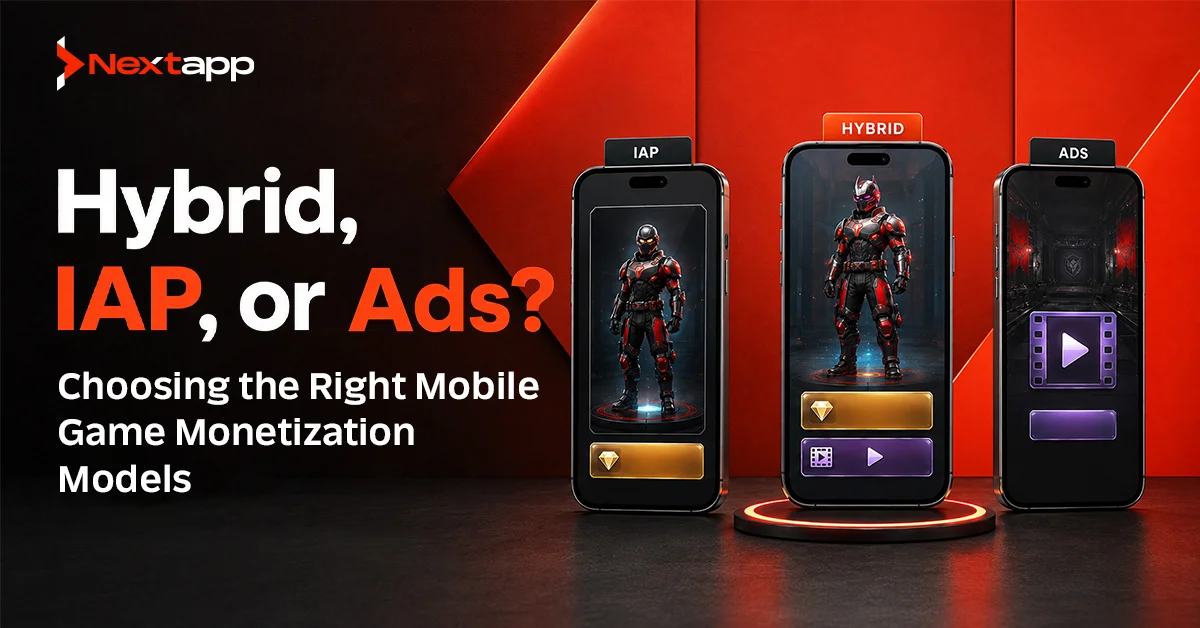
The Hybrid Model combines two or more revenue streams simultaneously, most commonly pairing IAP with rewarded advertising, and often adding a battle pass or subscription layer on top. Hybrid monetization is the dominant model among top-grossing mobile games in 2026 because it maximizes revenue across all player types simultaneously.
Hybrid casual games combining casual gameplay with deeper progression and hybrid monetization showed 37% revenue growth in 2024, making this the fastest-growing category in the market. The model works because different player segments have fundamentally different monetization behaviors. The Hybrid Model captures revenue from all of them.
The Four Player Segments and Their Monetization Behavior
Non-spenders (approximately 95% of all players) never purchase. They are monetized through advertising. Rewarded video opt-in rates among non-spenders exceed 70% when the reward is compelling. Micro-spenders (occasional buyers) purchase items priced $0.99 to $4.99 when a value-for-money trigger activates. Mid-tier spenders ($10 to $100 per month) are battle pass and subscription buyers who value ongoing commitment structures. High-value spenders (whales) spend $100 to $1,000+ monthly and respond to exclusivity, limited-time offers, and VIP systems.
The Hybrid Model creates revenue architecture that serves all four segments without requiring any single segment to generate all income. This reduces revenue concentration risk and improves LTV stability.
Hybrid Model Revenue Benchmarks
According to Sensor Tower and TekRevol 2026 data, hybrid-monetized games consistently achieve higher ARPDAU and longer player lifecycles than single-revenue-stream games. iOS mid-core hybrid games achieve Day 90 ARPU of $9.69 in high-income markets. Hybrid casual titles generate $0.15 ARPDAU via combined ads and IAP. Battle passes within hybrid systems convert 12 to 18% of active users versus 2 to 5% for standalone IAP.
The most critical implementation principle for hybrid monetization is phasing: rewarded ads from day one, IAP bundles at day three to seven, battle passes after the first content update. Introducing all elements simultaneously creates monetization fatigue before player loyalty is established.
Best Genres for Hybrid
Mid-core RPGs, casual puzzle with meta progression, battle royale mobile, simulation, and social games all benefit from hybrid architecture. Pure hyper-casual games typically use ad-only models initially, adding IAP elements as their audience becomes more engaged with the title.
For a detailed breakdown of which hybrid combinations generate the best revenue by platform, see the guide on mobile app monetization platforms, which covers mediation setup and network selection for hybrid-monetized games.
Model 4: Subscription-Based Model
The subscription model charges players a recurring fee (typically weekly, monthly, or annually) for ongoing access to premium content, features, or benefits. It is the fastest-growing mobile game monetization models category for mid-core and core audiences in 2026, driven by players’ increasing familiarity with subscription economics from Netflix, Spotify, and Apple Arcade.
Mobile game subscriptions in 2026 take four primary forms. Content subscriptions provide a monthly library of story chapters, seasonal areas, or exclusive maps. Battle pass subscriptions offer structured 30-day reward tracks combining free and paid tier progression. Utility subscriptions (remove ads, energy recharge speed, VIP perks) address the most common friction points at a recurring price. Cross-game subscriptions like Apple Arcade and Netflix Games provide library access without per-game monetization.
Subscription Revenue Benchmarks
Battle pass subscriptions convert 12 to 18% of active users per season, 3 to 6x higher than standalone IAP conversion. Monthly subscription pricing in mobile games ranges from $2.99 to $9.99. Annual plans at $19.99 to $49.99 generate 3 to 4 months of revenue upfront while locking in retention. According to TekRevol 2026 data, iOS users spend $1.08 per download, compared with $0.47 for Android users, making iOS the primary platform for subscription revenue for most studios.
Subscription Model Requirements
Subscriptions require one condition that other models do not: daily value justification. A subscription player who logs in and finds nothing new to do after three days cancels. Games that cannot commit to ongoing content creation at a pace that fills 30-day subscription periods should not lead with subscription models. The consistent requirement of delivery on subscription value makes this the most operationally demanding model.
Best Genres for Subscription
Strategy, RPG, competitive multiplayer, and simulation games with dedicated daily-playing audiences perform best under subscription models. Games where the battle pass structure (daily quests, seasonal progression, tiered unlocks) aligns with the core engagement loop convert subscriptions most reliably.
Understanding mobile game monetization trends around subscription models helps studios decide whether their planned content update cadence can sustain subscription player expectations.
Model 5: Pay-to-Play Model
The pay-to-play model requires payment before any gameplay access. Unlike premium (pay to download the complete game), pay-to-play in the mobile context typically refers to entry-fee tournament models, energy systems that reset on payment, or gated access mechanics where specific game modes require payment each session.
Traditional pay-to-play (paying per play) has declined in mobile gaming just as it declined in arcades. The current evolution of this model exists in skill-based tournament apps where players pay an entry fee to compete for a prize pool. Platforms like Skillz, Solitaire Cube, and Blackout Bingo use this structure. The model has a smaller addressable audience than free-to-play alternatives but serves competitive players who are willing to pay for fair, skill-determined competition.
Pay-to-Play Revenue Benchmarks
Tournament entry fees on skill-based platforms range from $0.25 to $25 per match. Top competitive players on these platforms earn $50 to $200 monthly by winning more than they enter. Platforms using this model must comply with state and jurisdictional gaming regulations, as the structure may fall under skill gaming laws in certain US states.
For players exploring this model from the consumer side, the guide on game apps that pay real money provides detailed payout data for the leading skill-based tournament platforms.
Choosing the Right Model for Your Game
Model selection follows a framework of four decision variables. Genre and audience: casual games with short sessions and broad audiences suit freemium and ad-based models. Mid-core and hardcore games with engaged audiences suit IAP, battle passes, and subscriptions. Content update capacity: models requiring ongoing content (subscriptions, battle passes) demand sustained production. If your team cannot deliver 30 days of meaningful updates per month, subscription models will produce churn rather than revenue. Player platform: iOS audiences generate 2 to 5x higher ARPU than Android in developed markets. iOS-first titles can support higher-priced premium and subscription offerings. Android-first titles benefit from ad volume. Revenue goals: immediate cash generation favors premium. Long-term LTV maximization favors hybrid and subscription.
The sequence that works for most new titles in 2026: launch free-to-play with rewarded ads and a starter IAP bundle. Add a battle pass after the first content update. Evaluate subscription viability at the 90-day retention data point. Consider premium pricing only for titles with established brand equity or niche audiences willing to pay upfront for a complete experience.
Common Monetization Model Mistakes
Six monetization model mistakes consistently reduce both revenue and retention across all model types. Selecting a model after the game is built creates an expensive redesign. The right mobile game monetization models choice must influence game design from the first production week. Adding pay-to-win mechanics to a competitive freemium game generates negative reviews that permanently damage organic discovery. Over-relying on whale spending without building monetization for the mid-tier creates fragile revenue that collapses when high-spenders churn. Setting subscription prices above the perceived ongoing value of content produces immediate cancellations and negative word-of-mouth. Using premium pricing without brand equity results in poor install conversion at costs that cannot be recovered through downstream revenue. Combining too many model elements at launch overwhelms new players with purchase prompts before they have built emotional investment in the game.
Conclusion
Choosing between mobile game monetization models is the most consequential decision in mobile game development. The freemium model provides the broadest market access and the most flexibility. The premium model provides immediate revenue but limited scale. The hybrid model provides the highest ARPDAU and LTV by capturing revenue from all player types. The subscription model provides predictable recurring revenue but demands ongoing content delivery. The pay-to-play model serves competitive audiences willing to risk entry fees for skill-based rewards.
The studios that outperform in 2026 make this decision during pre-production, not after launch. They align model choice with genre, audience, and content capacity. They use mobile game monetization statistics to benchmark their decisions against real market data. They understand that mobile game monetization alternatives without ads exist and are viable in the right contexts, and they design their entire game economy around their chosen model from the first design document.
If you are building a game and want expert guidance on monetization architecture from concept through launch, NextApp Inc. delivers full-cycle mobile game development services, including monetization system design, economy balancing, and live-ops revenue optimization. Contact our mobile game development company team today.
Frequently Asked Questions (FAQs)
Which mobile game monetization model makes the most money?
The Hybrid Model, combining IAP with rewarded advertising, generates the highest ARPDAU and LTV for most game types in 2026. Within hybrid strategy games lead all genres with $17.5 billion in IAP revenue in 2024. For a full breakdown by genre, see the guide on best mobile game monetization for revenue.
What is the difference between freemium and hybrid?
Freemium describes the access model (free to download, optional purchases). Hybrid describes the revenue structure (multiple revenue streams combined). A hybrid game is typically also freemium. Not every freemium game is a hybrid. Hybrid specifically refers to combining IAP with advertising, subscriptions, or battle passes as simultaneous revenue streams.
When should I use a subscription model?
Use subscriptions when your game has daily engagement loops, regular content updates, and an audience that plays consistently enough to justify a recurring payment. Battle passes are the most accessible entry point into subscription mechanics because they have a defined endpoint (30 days) that reduces cancellation hesitation.
How do I decide between ads and IAP as my primary model?
Casual games with high DAU and short sessions suit ad-primary models. Mid-core games with engaged players and progression depth suit IAP-primary models. Use mobile game monetization statistics from comparable titles in your genre to benchmark which model generates higher ARPDAU for your specific player profile.
What is the best monetization model for a new indie developer?
Start with freemium plus rewarded ads. This model has the lowest barrier to market (free download), monetizes all player types, and requires the least upfront economy design complexity. Add IAP bundles after launch once you have data on what players value. See the companion guide on how to make a game app from scratch for how to plan monetization during the development process.
What should I understand about game development before choosing a monetization model?
Understanding what is game development at a systems level, including game development stages and how production phases connect to monetization design, ensures your model choice is integrated into the game from the architecture level. For studios building from concept, see the mobile game development services guide for how professional studios structure their monetization design workflow.