

Key Takeaways
- Game development is the full process of designing, building, and launching a game, from concept to deployment.
- The global gaming market is projected to grow from $343.22 billion in 2025 to $386.04 billion in 2026, at a CAGR of 12.5%.
- Core disciplines inside game development include game design, game programming, game art and animation, and sound design.
- Modern developers use game engines like Unity, Unreal Engine, and Godot to accelerate production.
- Games ship across multiple platforms, mobile, PC, console, and cloud, making mobile game development the single largest revenue segment.
- AI, AR/VR, and cloud gaming are the three dominant technology forces reshaping development workflows in 2026.
- Anyone entering this field, whether as a developer, artist, or designer, needs to understand all core disciplines to build competitive, market-ready products.
Introduction
If you have ever played a game and wondered how it was made, you are already asking the right question. What is game development? It is the complete creative and technical process of building a game, covering every stage from initial idea to the moment a player presses start. In 2026, it is also one of the most economically significant disciplines in the technology industry.
The gaming industry now reaches 3.58 billion players worldwide, with 83% of those players using mobile devices. Revenue is projected to reach $386.04 billion in 2026, growing at 12.5% annually. That scale makes game development not just a creative pursuit, but a full commercial ecosystem, one that involves programmers, artists, sound designers, producers, marketers, and platform engineers working in concert.
This guide breaks down every core element of game development: the key roles, the tools professionals use, the platforms games run on, and the technologies defining the industry in 2026. Whether you are a beginner exploring the field or a business evaluating a mobile game development company, this is your complete reference.
What Is Game Development?
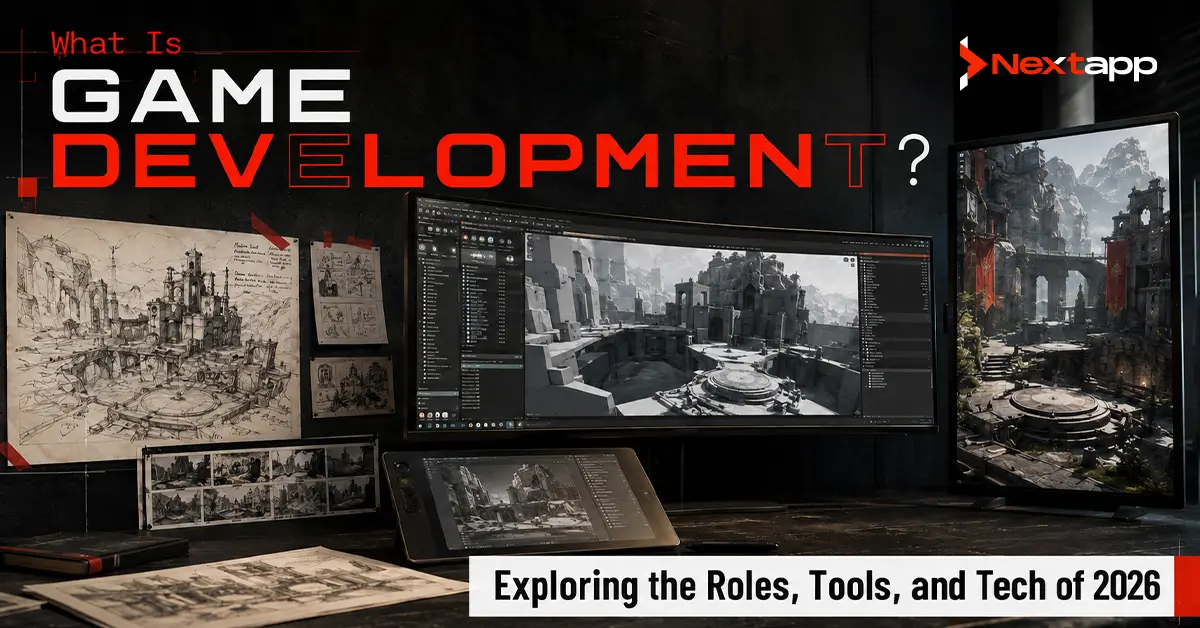
Game development is the art and science of creating interactive software experiences, commonly called games. It covers the full production lifecycle: concept generation, game design, game programming, asset creation, testing, and release.
A game can be built by a single developer over a weekend or by a studio of 500 people over 5 years. Size does not define the category. What defines a game is interactivity; a player must be able to make decisions, manipulate elements, and receive feedback from the system.
Game development is not a single job. It is a collaboration between multiple disciplines:
- Game designers define rules, mechanics, and player progression.
- Game programmers write the code that makes the design run.
- Game artists and animators build the visual world.
- Sound designers create audio that makes the experience feel real.
- QA testers identify and eliminate bugs before release.
- Producers manage timelines, budgets, and team coordination.
Understanding what each role contributes, and how they connect, is the foundation of any serious discussion about the field.
The Core Disciplines of Game Development
Game Design
Game design is the architectural foundation of every project. A game designer creates the rules, goals, player mechanics, level structures, reward systems, and overall experience logic. Great game design answers three questions: What can the player do? What should they feel? What keeps them coming back?
In 2026, game design increasingly incorporates data-driven decision-making. Designers study retention metrics, session lengths, and in-game behavior to refine loop structures mid-production. Game design connects directly to mobile game monetization; how a game generates revenue is built into the design from day one, not added afterward.
Key outputs of game design include:
- Core loop documentation (what the player does every session)
- Level design maps and progression trees
- Economy and reward system blueprints
- Narrative and dialogue scripts
Game Programming
Game programming translates design documents into functional software. A game programmer writes code that controls everything: physics, collision detection, AI behavior, multiplayer networking, rendering, input handling, and performance optimization.
Game programming languages widely used in 2026 include C++, C#, Python, and Lua. The choice of language depends on the game engine being used and the target platform. Unity developers primarily write in C#, while Unreal Engine projects rely heavily on C++ with Blueprints visual scripting for rapid prototyping.
In larger studios, game programming splits into specializations:
- Engine programmers build or maintain the core technology layer.
- Gameplay programmers implement mechanics directly from design specs.
- Graphics programmers handle rendering pipelines and visual effects.
- Network programmers build the systems that support multiplayer functionality.
The game development stages, pre-production, production, and post-launch, each demand a different programming focus. Pre-production prioritizes prototyping; production prioritizes stability and feature completion; post-launch prioritizes performance, live service updates, and bug fixes.
Game Art and Animation
Game art and animation define what players see. This discipline encompasses everything visual, character models, environment assets, UI elements, particle effects, lighting, and cinematic sequences. The quality of game art directly affects perceived production value, which drives download rates and player retention.
Game art production typically runs on a pipeline involving:
- Concept art, 2D illustrations establishing visual style and character direction.
- 3D modeling, Building assets in software like Maya, Blender, or ZBrush.
- Rigging and animation, Defining skeletal structures and creating movement sequences.
- Texturing, Applying color, material, and surface detail to 3D models.
- VFX, Creating effects like explosions, weather, and magic systems.
In 2026, AI-assisted art generation tools have entered professional pipelines, helping studios produce concept iterations and texture variations faster. However, senior game art directors still define visual style and quality standards manually. Automated tools assist, they do not replace, experienced artists.
Sound Design in Games
Sound design in games builds the audio layer that makes every action feel consequential. A step on gravel, the impact of a sword, ambient wind, a character’s breathing, all of these are crafted assets, not recordings pulled from a library.
Sound design in a full production involves:
- Foley and effects, Creating custom sounds for in-game actions and events.
- Music composition, Writing adaptive soundtracks that respond to gameplay state.
- Voice acting direction, Casting and recording character dialogue.
- Audio implementation, Integrating all audio assets into the game engine through middleware like FMOD or Wwise.
Quality sound design in games is one of the most underestimated factors in player immersion. Studies in the field consistently show that audio directly impacts how challenging, exciting, or emotionally resonant a game feels, even when players are not consciously aware of it.
The Game Development Process: From Concept to Launch
Successful game development follows a structured production pipeline. Understanding what is game development and its stages helps both developers and clients manage scope, budget, and timeline effectively.
Stage 1, Pre-Production: Define the concept, genre, target audience, and platform. Create a Game Design Document (GDD). Build a small prototype to validate core mechanics. This stage answers: is this game worth making?
Stage 2, Production: All disciplines work in parallel. Programmers code systems while artists build assets. Game design evolves based on playtesting. This is the longest and most resource-intensive phase.
Stage 3, Alpha: A playable version of the game exists with all major features present, though incomplete. Internal testing begins. Bugs are catalogued.
Stage 4, Beta: The game is content-complete. External or closed beta testing runs. Performance issues, balance problems, and remaining bugs are addressed.
Stage 5, Launch: The game ships to its target platforms. Marketing campaigns activate. Metrics tracking begins immediately.
Stage 6, Post-Launch (Live Operations): In 2026, most successful games, especially mobile titles, continue operating as live services. Content updates, seasonal events, and balance patches extend player lifetime value. For anyone planning to make a game app from scratch, building a post-launch roadmap into the original plan is now a production standard, not an afterthought.
Game Engines: The Core Development Tools of 2026
A game engine is the software framework that provides pre-built systems for rendering, physics, input handling, audio, and more. Developers use a game engine to avoid building foundational technology from scratch, freeing time for game-specific programming and design.
The game engine market was valued at $1.6 billion in 2026 and is projected to grow at a CAGR of 6.8% through 2035. The most widely used engines in 2026 include:
Unity, The dominant choice for mobile game development and indie projects. Supports 27 deployment platforms. Runs on C#. Excellent for 2D and mid-tier 3D projects. Powers a significant share of global mobile game development services.
Unreal Engine 5, The industry standard for high-fidelity AAA production. Uses C++ and Blueprint visual scripting. Powers titles with photorealistic graphics and large open worlds. Nanite and Lumen systems deliver real-time geometry and lighting at scale.
Godot, An open-source engine gaining strong traction among indie developers. Uses GDScript (Python-like syntax) and C#. Lightweight and increasingly capable for 2D and 3D production.
GameMaker, Purpose-built for 2D games. Used extensively for indie titles. Accessible entry point for beginners entering game programming.
CryEngine and Frostbite, Proprietary engines used by large studios (Crytek and EA, respectively) for first-person and simulation titles with advanced environmental rendering.
Choosing the right game engine is one of the first and most consequential decisions in any game development project. Platform targets, team size, budget, and genre all influence this choice.
Platforms for Game Development
Games ship to multiple platforms in 2026, and developers design for platform requirements from the start.
Mobile (iOS and Android), The single largest segment in global gaming, generating more than $126.1 billion in 2025. Mobile game development dominates in user volume and accessibility. Touch interfaces, shorter session design, and mobile game monetization models (in-app purchases, ads, subscriptions) define this platform’s design constraints.
PC, The second-largest platform by active users. PC gaming accounts for 26% of the global player base, with 936 million players. Developers target PC via Steam, Epic Games Store, and direct distribution. PC allows maximum technical flexibility and highest graphical fidelity.
Console (PlayStation 5, Xbox Series X/S, Nintendo Switch), Console gaming commands a premium audience willing to pay full retail price. PlayStation 5 and Xbox Series X/S each carry libraries of 115+ major titles. Console certification requirements add QA complexity and timeline overhead.
Cloud Gaming, The fastest-growing platform segment, is expanding from $10.5 billion currently to a projected $28.6 billion by 2030. Cloud gaming removes hardware barriers for players, running games server-side and streaming output. This creates new optimization requirements for game developers, latency, compression, and server-side rendering all become critical variables.
VR/AR, including augmented reality and virtual reality platforms, represents a smaller but rapidly growing audience. Meta Quest, PlayStation VR2, and mixed-reality headsets drive this segment. What is game development for VR? It demands unique design principles focused on spatial interaction, motion comfort, and immersion depth.
The 2026 development philosophy is “build once, play anywhere”; most professional studios target at least 2 platforms from the outset.
AI, AR/VR, and Cloud: The Technology Forces Shaping Game Development in 2026
Three technology categories are actively redefining how game development works at a production level in 2026.
Artificial Intelligence is now embedded across the production pipeline. AI tools assist with procedural content generation, NPC behavior systems, automated playtesting, bug detection, and even narrative branching. Developers use AI to prototype faster and validate design decisions earlier. AI is not replacing human creativity, it is compressing iteration cycles, which is especially valuable for studios managing tight budgets.
AR and VR have introduced entirely new design paradigms. Spatial computing requires game designers to think in three dimensions by default. Depth perception, physical comfort, and environmental interaction become core design variables. The game development solution market, which reached $560 million in 2026, is growing at 11.6% annually, driven significantly by AR/VR tooling demand.
Cloud Gaming and Cross-Platform Infrastructure allow developers to build games that run across devices without per-platform rebuilds. Cloud-native architectures support real-time multiplayer at scale, live service operations, and seamless updates. For mobile game development services, cloud backends are now standard for any title that includes social or competitive features.
Career Paths in Game Development
Game development supports a broad range of career trajectories. The six most in-demand roles entering 2026 are:
Game Designer, Creates game systems, mechanics, and level architecture. Requires creativity, analytical thinking, and deep familiarity with player psychology.
Game Programmer/Engineer, Builds the software systems that make games run. Requires proficiency in C++, C#, or Python, plus engine-specific knowledge.
3D Artist/Animator, Creates characters, environments, and animations. Requires skill in Maya, Blender, ZBrush, or Substance Painter.
Sound Designer, Builds audio assets and implements them in-engine. Requires expertise in FMOD, Wwise, and digital audio workstations.
QA Engineer, Tests games systematically, identifies bugs, and validates fixes. Requires structured thinking and thoroughness.
Producer/Project Manager, Manages timelines, budgets, and cross-discipline coordination. Requires organizational discipline and communication skills.
For anyone exploring how to make a game app from scratch, understanding these roles helps decide whether to hire specialists, work with a full-service studio, or begin learning independently.
Game Development and Monetization: What Developers Need to Know
Building a game is only half the equation. Getting it played, and generating revenue, requires deliberate strategy. Understanding mobile game monetization from the start of production prevents costly redesigns later.
The three primary mobile game monetization models in 2026 are:
In-App Purchases (IAP), Players buy virtual items, currency, or cosmetics. This model dominates mobile revenue globally.
Advertising, Ad revenue in mobile gaming through rewarded video, interstitials, and banner placements. Works best for free-to-play games with high daily active user counts.
Subscription, Players pay a recurring fee for access or premium content. Increasingly common across PC, console, and mobile.
The most profitable mobile game monetization strategy depends on genre, audience, and platform. A puzzle game favors rewarded ads. A multiplayer RPG favors IAP. A fitness game may favor subscriptions. Developers who want to make money playing video games or build businesses around their titles need to evaluate mobile game monetization trends early and design systems that support chosen revenue models from launch.
For games looking to stand out in crowded app stores, learning how to advertise your mobile games is equally critical. Distribution strategy and user acquisition spending directly determine whether a well-built game reaches its audience or disappears at launch.
Conclusion
What is game development in 2026? It is a mature, multidisciplinary industry operating at a scale that rivals that of film and music combined. It demands expertise across game design, game programming, game art and animation, sound design, and platform engineering, all coordinated across structured game development stages from concept to live service.
The global player base now exceeds 3.58 billion people. Revenue is approaching $400 billion. Mobile remains the largest platform. AI, AR/VR, and cloud infrastructure are compressing timelines and expanding what small teams can build. And the studios and developers who understand mobile game monetization trends from the beginning of production are the ones who turn great games into sustainable businesses.
Whether you are an aspiring developer, an entrepreneur evaluating mobile game development cost, or a brand exploring mobile game monetization alternatives without ads, the fundamentals remain the same: great games start with a clear design, run on reliable technology, and reach their audience through smart distribution.
If you are ready to build, NextApp Inc. delivers end-to-end mobile game development services, from concept and engine selection through launch, live operations, and monetization strategy. Get in touch to start your project.
Frequently Asked Questions (FAQs)
What is game development in simple terms?
Game development is the process of creating a game, covering design, programming, art, sound, testing, and release. It combines creative vision with technical execution to build interactive experiences for players.
How long does game development take?
Timelines vary by scope. A simple mobile game takes 3–6 months. A mid-size title takes 12–24 months. A full AAA production takes 3–7 years. Game development stages, from pre-production to post-launch live ops, all contribute to the total timeline.
Do you need to know how to code to make a game?
No. Coding is one path, but game development includes non-programming roles like art, design, and sound. Engines like Unity and Unreal also provide visual scripting tools that reduce code dependency for non-programmers.
What is the best game engine for beginners?
Unity is the most recommended starting point for beginners because of its large documentation base, active community, and C# scripting support. Godot is a strong open-source alternative for those building 2D projects.
What platforms should I target for my first game?
Mobile, specifically Android and iOS, is the most accessible entry point for first-time developers. The barrier to distribution is lower, the audience is larger, and mobile game development services are widely available to support production.
What are the most profitable game monetization strategies?
In-app purchases combined with rewarded ad placements are the dominant revenue combination for mobile. For premium PC/console games, DLC and season passes generate strong post-launch revenue. The best mobile game monetization for revenue consistently comes from titles that design their economy systems before writing production code.