

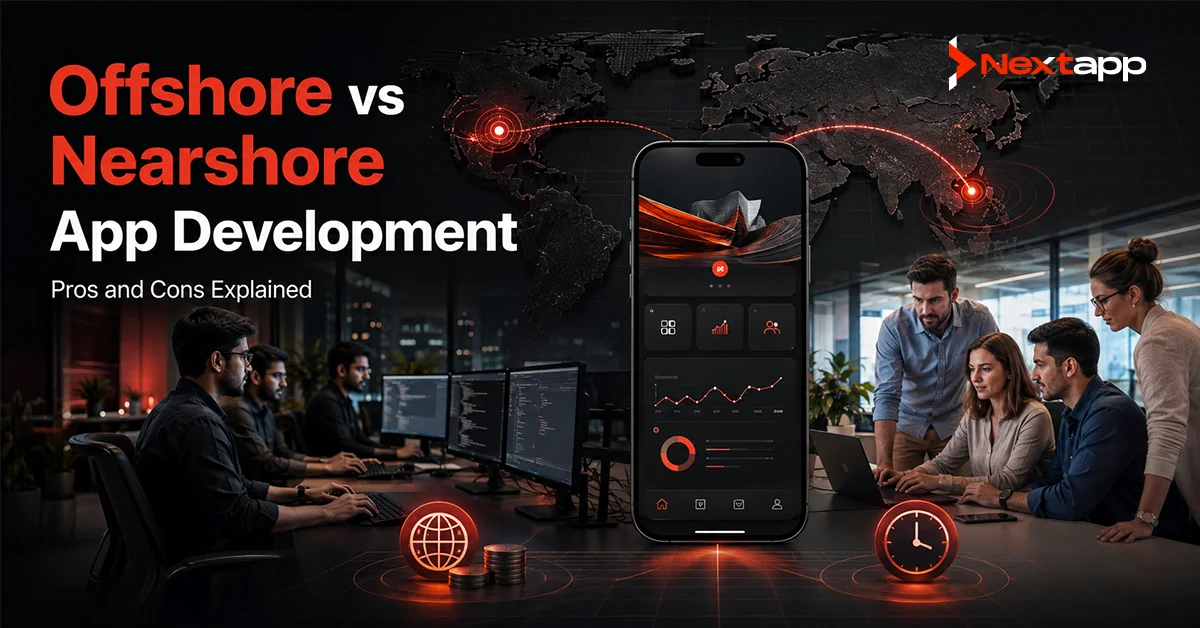
Offshore vs nearshore app development pros and cons come down to cost, communication, time zones, talent availability, collaboration needs, project complexity, and risk tolerance. Offshore app development usually means hiring a development team in a faraway country, often with a major time zone difference. Nearshore app development means hiring a team in a nearby country or region with closer working hours and easier collaboration.
Both models can work well. Offshore development can reduce costs and give access to a larger global talent pool. Nearshore development can improve communication, speed up collaboration, and make project management easier because the team is closer in time zone, culture, and sometimes geography.
The right choice depends on your app goals. Whether you need Android app development, mobile game development, cross-platform app development, or education app development, a simple MVP with a limited budget may work well with an offshore team. A complex mobile app that needs daily collaboration, fast feedback, strong compliance, and stakeholder involvement may benefit from a nearshore partner.
What Is Offshore App Development?
Offshore app development means hiring a mobile app development team located in a distant country, usually far from your business’s home region. For example, a company in the United States may hire an offshore team in India, Pakistan, the Philippines, Vietnam, Ukraine, or another country with a strong software development market.
The main reason companies choose offshore development is cost efficiency. Offshore teams often offer lower hourly rates than domestic teams, which can make app development more affordable. Businesses can also access developers with different technical skills, including mobile app developers, backend engineers, QA testers, UI/UX designers, DevOps engineers, and project managers.
Offshore development is common for startups, agencies, enterprise companies, and businesses that need scalable technical support. It can be useful for building MVPs, adding features, maintaining apps, testing software, or expanding an existing development team.
However, offshore development also comes with challenges. Time zone differences, communication gaps, cultural differences, language barriers, and project management complexity can affect delivery if the process is not managed carefully.
What Is Nearshore App Development?
Nearshore app development means hiring a development team in a nearby country or region. For a US company, this may include teams in Mexico, Colombia, Costa Rica, Argentina, Brazil, or other Latin American countries. For a company in Western Europe, nearshore teams may be located in Eastern Europe, Portugal, Spain, or nearby regions.
The main advantage of nearshore development is easier collaboration. Nearshore teams often work in similar or overlapping time zones, which makes meetings, feedback, updates, and issue resolution faster.
Nearshore development can also offer cultural alignment, stronger communication efficiency, and easier travel for workshops or in-person collaboration. It may cost more than offshore development, but it is often less expensive than hiring an onshore team in the same country.
Nearshore development is often a strong choice for businesses that need regular communication, agile development, fast iteration, stakeholder involvement, and closer project control.
Offshore vs Nearshore App Development: The Core Difference
The core difference between offshore and nearshore app development is distance. Offshore teams are usually farther away and may work in very different time zones. Nearshore teams are closer and usually have more overlapping work hours.
This difference affects communication, project management, cost, speed, collaboration, and risk. Offshore teams may help reduce budget pressure. Nearshore teams may make it easier to manage complex projects.
The decision is not only about geography. It is about the kind of working relationship your app project needs.
If your project is clearly defined, well-documented, and less dependent on daily collaboration, offshore development can work well. If your project is evolving quickly and needs frequent stakeholder feedback, nearshore development may be easier to manage.
Cost Advantages of Offshore App Development
Cost is the biggest reason many companies choose offshore app development. Offshore teams often have lower hourly rates than onshore or nearshore teams. This can make development more accessible for startups and small businesses with limited budgets.
Offshore app development can also help companies increase output without hiring full-time in-house employees. Instead of building an internal team, a business can hire an offshore development company for a specific project, feature set, or long-term support plan.
Lower cost does not automatically mean lower quality. Many offshore teams are highly skilled and experienced. However, businesses should be careful when choosing vendors based only on price. Very low pricing may lead to weak planning, poor code quality, communication issues, or hidden costs later.
A strong offshore team should provide clear scope, transparent pricing, project milestones, testing standards, and communication processes.
Cost Considerations of Nearshore App Development
Nearshore app development is usually more expensive than offshore development but less expensive than fully onshore development. The higher cost often reflects better time zone alignment, easier communication, and closer collaboration.
For many companies, nearshore development offers a useful middle ground. It can reduce costs compared with hiring locally while still giving the business more control than a far-off offshore model.
Nearshore development may also save money indirectly. Faster communication can reduce delays. Easier collaboration can prevent misunderstandings. Better alignment can reduce rework. Shorter feedback cycles can help the app move forward more smoothly.
When comparing costs, businesses should not only look at hourly rates. They should also consider project delays, quality problems, management time, bug fixing, and long-term maintenance.
Talent Availability in Offshore and Nearshore Markets
Talent availability is one of the major advantages of both offshore and nearshore app development. Businesses can access developers outside their local hiring market and build teams faster.
Offshore markets often provide a large talent pool. This can be helpful when a company needs developers with specific skills, such as Flutter, React Native, Swift, Kotlin, Node.js, Python, QA automation, cloud engineering, or backend development.
Nearshore markets may have a smaller talent pool than major offshore hubs, but they can still offer strong technical expertise. The advantage is that the team may be easier to collaborate with because of similar working hours and cultural familiarity.
The right talent model depends on the project. If your app needs a large development team quickly, offshore may offer more options. If your app needs close collaboration with product managers, designers, and business stakeholders, nearshore may be more practical.
Time Zone Differences and Their Impact
Time zone differences can affect app development more than many businesses expect. Offshore teams may be eight to twelve hours ahead or behind your local time. This can create delays in feedback, decision-making, and issue resolution.
For example, if your team sends feedback at the end of your workday, the offshore team may not see it until their next day. A small clarification can take twenty-four hours. Over several weeks, these small delays can slow the project.
Nearshore teams usually have better time zone overlap. This makes it easier to hold meetings, review designs, test builds, solve blockers, and make decisions quickly.
Offshore time zone differences can still be managed. Clear documentation, scheduled overlap hours, project management tools, and structured updates can reduce delays. However, projects with constant change may feel harder to manage offshore.
Communication Efficiency
Communication efficiency is one of the most important factors in app development. A mobile app project involves product decisions, design feedback, technical questions, testing updates, bug reports, and launch planning.
Nearshore development often improves communication because teams are available during similar working hours. This allows faster responses and more natural collaboration.
Offshore teams can also communicate well, but the process must be structured. Weekly calls may not be enough for active projects. Businesses should use clear documentation, daily updates, sprint planning, shared task boards, and recorded explanations when needed.
Poor communication can cause scope confusion, missed details, duplicated work, and delays. Strong communication can make even a distributed team feel organized and reliable.
Cultural Alignment and Work Style
Cultural alignment can influence how teams communicate, solve problems, ask questions, and handle feedback. Nearshore teams may share more similar business practices, work expectations, and communication styles with the client.
This can make collaboration easier, especially in projects where product direction changes often. Teams may understand customer expectations, market behavior, and communication tone more naturally.
Offshore teams can also work very successfully with international clients, especially experienced development companies that have strong processes. However, cultural differences may require clearer expectations.
For example, some teams may avoid challenging client ideas directly unless invited to do so. A good app development partner should be comfortable asking questions, raising concerns, and recommending better solutions when needed.
Project Management Complexity
Project management complexity increases when teams are distributed across locations, time zones, and cultures. Offshore development often requires stronger project management because the team may not be available during your main working hours.
A good offshore project should have clear documentation, milestone planning, sprint cycles, task tracking, regular status updates, QA checkpoints, and defined approval processes.
Nearshore development can reduce project management friction because real-time collaboration is easier. Product managers, designers, developers, and stakeholders can meet more often and resolve blockers faster.
However, nearshore does not remove the need for project management. Every app project still needs a clear roadmap, scope control, communication process, and delivery structure.
Quality Considerations
Quality depends more on the vendor than the location. There are excellent offshore teams and weak nearshore teams. There are also excellent nearshore teams and weak offshore teams.
When evaluating quality, review the company’s portfolio, code standards, testing process, technical architecture, QA methods, security practices, and client references.
Ask how the team handles bug tracking, code reviews, automated testing, device testing, app store preparation, and post-launch support. Ask who owns quality assurance and how issues are reported.
A low-cost offshore team without a strong QA process can become expensive later. A nearshore team without strong technical leadership can also create problems. Location is only one factor. Process and expertise matter more.
Speed of Delivery
Speed of delivery depends on team size, experience, communication, scope clarity, and decision-making. Offshore development can be fast when the project is well-defined and the team has enough resources. Some offshore companies can scale teams quickly, which can increase development output.
Nearshore development can be faster for projects that need frequent collaboration. Similar time zones allow faster feedback, faster approvals, and faster problem solving.
A project may slow down if the client delays decisions, changes requirements often, or provides unclear feedback. This can happen with both offshore and nearshore teams.
The fastest projects usually have clear requirements, strong project management, a stable scope, and active communication from both sides.
Travel and Collaboration Ease
Nearshore development often makes travel easier. If your team needs in-person workshops, strategy sessions, design reviews, or launch planning, a nearby country can be more practical.
Travel may not be necessary for every app project, but it can be helpful for complex products, enterprise systems, or long-term partnerships.
Offshore travel can be more expensive and time-consuming. Flight duration, visa requirements, travel costs, and scheduling can make in-person collaboration less frequent.
For fully remote projects, this may not matter. For projects that benefit from occasional face-to-face collaboration, nearshore development may be a better fit.
Language Barriers
Language barriers can affect requirements, feedback, documentation, and issue resolution. Many offshore and nearshore teams work in English, but fluency levels can vary.
A language gap does not only mean grammar or vocabulary. It can also affect how clearly technical ideas, risks, delays, and recommendations are explained.
During vendor evaluation, pay attention to communication quality in emails, calls, proposals, and discovery sessions. If communication feels unclear before the project starts, it may become harder during development.
Nearshore teams may have stronger alignment with your preferred language depending on the region. Offshore teams can also communicate very well if they have experienced client-facing project managers and business analysts.
Legal and Compliance Issues
Legal and compliance issues should be reviewed carefully before hiring offshore or nearshore app developers. App projects may involve intellectual property, user data, contracts, confidentiality, payment terms, and compliance requirements.
Different countries have different legal systems, data protection rules, tax requirements, and contract enforcement processes. This matters if your app handles sensitive information or operates in regulated industries.
For healthcare, fintech, insurance, education, and enterprise apps, legal review is especially important. You may need data processing agreements, NDAs, security clauses, code ownership terms, and compliance commitments.
Nearshore vendors may operate under legal frameworks that are easier for your company to understand or manage. Offshore vendors may require more detailed contract review, especially for sensitive projects.
Data Security Concerns
Data security should be a priority in both offshore and nearshore development. Mobile apps often handle personal data, payment information, login credentials, location data, customer records, or proprietary business logic.
Before hiring a vendor, ask how they protect code, credentials, servers, APIs, and user data. Ask about access control, secure repositories, password management, development environments, encryption, backups, and security testing.
Never share production credentials casually. Make sure access is limited and documented. Sensitive information should be shared through secure systems, not open chat messages.
A trustworthy vendor should have clear data security practices and be willing to follow your company’s security requirements.
Scalability of Teams
Scalability of teams refers to how easily a vendor can add more developers, designers, testers, or specialists as the project grows. Offshore development often has an advantage here because larger offshore companies may have bigger talent pools and flexible staffing.
This can be helpful when a startup needs to move from MVP to full product or when an enterprise needs ongoing feature development.
Nearshore teams can also scale, but availability may depend on the vendor’s size and regional talent market. Smaller nearshore firms may offer stronger collaboration but limited scaling capacity.
Before choosing a vendor, ask how they handle team expansion. Can they add mobile developers, backend engineers, QA testers, DevOps specialists, or UI/UX designers when needed? How quickly can they scale? How do they maintain quality when the team grows?
Risk Factors in Offshore Development
The main risks of offshore development include time zone delays, communication gaps, unclear requirements, quality inconsistency, hidden costs, weak project management, and legal complexity.
These risks can be reduced with careful vendor selection. Choose an offshore company with strong references, transparent pricing, experienced project managers, clear documentation, and a proven delivery process.
Avoid vendors that promise unrealistic timelines, provide vague proposals, or avoid detailed technical discussions. Low rates are not enough if the team cannot deliver quality work.
Offshore development works best when the project scope is clear, communication is structured, and the vendor has experience working with international clients.
Risk Factors in Nearshore Development
Nearshore development also has risks. It may cost more than offshore development. The talent pool may be smaller depending on the region. Some vendors may market themselves as nearshore but still outsource work to other regions without clear disclosure.
Nearshore teams can also have quality issues if their process is weak. Similar time zones do not guarantee good development practices.
Businesses should still evaluate portfolios, references, technical skills, contracts, communication, and support terms carefully.
Nearshore development reduces some collaboration risks, but it does not remove the need for due diligence.
Best-Fit Scenarios for Offshore App Development
Offshore app development can be a good fit when budget is a major priority and the project can be clearly documented. It works well for MVPs, feature development, maintenance tasks, QA testing, backend support, and projects with stable requirements.
It may also work well when a company needs to scale technical capacity quickly or access specialized talent not available locally.
Offshore development is best when the client has a strong internal project owner or the vendor provides a capable project manager. Clear communication and documentation are essential.
Best-Fit Scenarios for Nearshore App Development
Nearshore app development is a good fit when collaboration matters as much as cost. It works well for projects that need frequent meetings, fast iteration, design feedback, stakeholder involvement, and agile development.
It is also useful for complex apps, regulated industries, enterprise projects, and long-term product partnerships.
Nearshore development is often a strong option for companies that want cost savings compared with onshore development but do not want the communication challenges of a distant offshore team.
Decision Criteria: How to Choose Between Offshore and Nearshore
To choose between offshore and nearshore app development, start with your project priorities. If budget is the strongest concern and your scope is clear, offshore may be suitable. If collaboration, speed, and communication are more important, nearshore may be worth the higher cost.
Consider your app complexity. A simple app with standard features may work well offshore. A complex product with evolving requirements may benefit from nearshore collaboration.
Consider your internal capacity. If your team can manage detailed documentation and delayed feedback cycles, offshore can work. If your team needs real-time discussions and faster decision-making, nearshore may be easier.
Also consider legal, compliance, and data security requirements. Sensitive projects may need stronger vendor controls, regardless of location.
Offshore vs Nearshore App Development: Quick Comparison
Offshore development usually offers lower cost, larger talent availability, and strong scaling potential. It may also involve larger time zone differences, more communication planning, and higher project management complexity.
Nearshore development usually offers better time zone overlap, easier collaboration, stronger communication efficiency, and easier travel. It may cost more than offshore and may have a smaller talent pool depending on the region.
Both models can produce high-quality apps when managed properly. The best choice depends on your business goals, project complexity, timeline, and budget.
Final Thoughts
Offshore vs nearshore app development pros and cons should be judged by fit, not by assumptions. Offshore development can be cost-effective and scalable when the scope is clear and communication is well-managed. Nearshore development can be more collaborative and efficient when the project needs frequent feedback, faster decisions, and closer alignment.
The right partner matters more than the location label. A reliable offshore team can outperform a weak nearshore team. A strong nearshore team can save time and reduce project risk compared with a poorly managed offshore option.
Before making a decision, compare vendors based on technical ability, communication quality, project management process, portfolio, pricing transparency, security practices, legal terms, and post-launch support.
A mobile app is a long-term investment. Choose the development model that supports your budget, your users, and your product vision.
Frequently Asked Questions
What is offshore app development?
Offshore app development means hiring a development team in a distant country, often with a significant time zone difference. Companies often choose offshore teams for cost savings, access to global talent, and scalable development capacity.
What is nearshore app development?
Nearshore app development means hiring a development team in a nearby country or region. It usually offers better time zone overlap, easier communication, and smoother collaboration than offshore development.
Is offshore app development cheaper than nearshore development?
Offshore app development is usually cheaper than nearshore development because labor costs are often lower in offshore markets. However, the total cost depends on quality, communication, project management, rework, and long-term maintenance.
Is nearshore development better for complex app projects?
Nearshore development is often better for complex projects that need frequent collaboration, fast feedback, stakeholder meetings, and agile decision-making. Similar time zones can make project management easier.
What are the main risks of offshore app development?
The main risks include time zone delays, communication gaps, cultural differences, language barriers, hidden costs, quality issues, legal concerns, and data security risks. These can be reduced by choosing a reliable vendor with strong processes.
Can offshore teams build high-quality mobile apps?
Yes, offshore teams can build high-quality mobile apps when they have the right technical skills, project management, QA process, communication standards, and security practices. Quality depends on the vendor, not only the location.
How do I choose between offshore and nearshore app development?
Choose offshore if budget and team scalability are top priorities and your scope is clear. Choose nearshore if collaboration, time zone alignment, faster feedback, and easier project management are more important.