

Key Takeaways
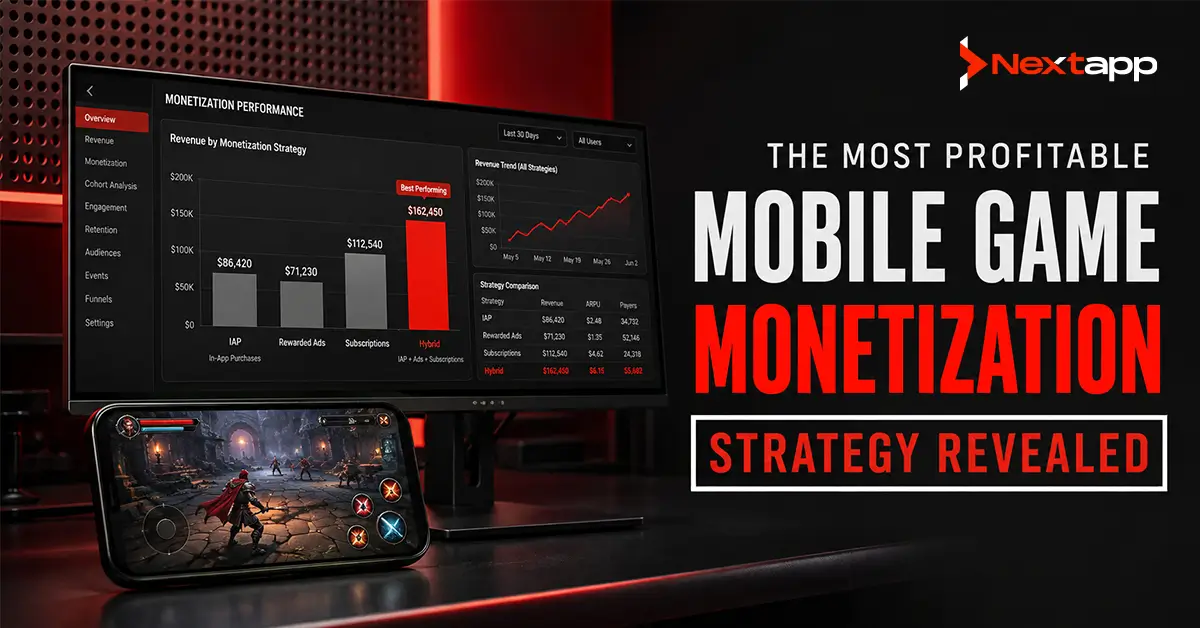
- The most profitable mobile game monetization strategy in 2026 is hybrid monetization combining IAP, rewarded advertising, and a battle pass or subscription layer, calibrated to genre and audience.
- Hybrid-monetised games achieve ARPDAU of $0.15 to $0.30 for mid-core titles and $0.08 to $0.15 for casual titles, significantly outperforming single-model approaches across all genre categories.
- Live ops monetisation through seasonal events, limited-time offers, and community challenges boosts ARPDAU by 30 to 50% during active event periods without requiring permanent content additions.
- Dynamic pricing models that adjust offer pricing based on geography, device, and individual player behaviour increase IAP conversion by 30 to 50% over static pricing inventories.
- Engagement-driven monetisation, where revenue systems are embedded within the core gameplay loop rather than interrupting it, generates higher LTV and lower churn across all game genres.
- The top 2.5% of paying users generate 90% of total IAP revenue. The most profitable studios design separate monetisation tracks for whale, mid-tier, and casual player segments simultaneously.
- Monetisation strategy must be designed during pre-production. Games that retrofit monetisation post-launch consistently underperform those that build revenue systems into the core loop from day one.
Introduction
Every mobile game developer wants to know the same thing: what is the most profitable mobile game monetization strategy and how do I implement it? The answer is not a single model. It is a layered architecture that matches revenue mechanisms to player behaviour, genre expectations, and content update capacity. But it has a clear structure, a documented performance record, and specific implementation practices that separate studios generating exceptional ARPDAU from those generating average results.
The global mobile gaming market generates over $126.1 billion annually in mobile-specific revenue. The top-grossing games do not win that revenue through luck or superior gameplay alone. They win it through monetisation systems that are designed as carefully as the game mechanics themselves. They treat revenue as a design discipline, not a business decision made after shipping. And they use data from every session to continuously optimise what they charge, when they charge it, and who they charge it to.
This guide reveals the most profitable mobile game monetization strategy in full, covering hybrid monetisation architecture, live ops revenue, dynamic pricing, and engagement-driven monetisation design. Every section includes the data supporting the approach and the practical decisions studios need to make to implement it.
The Foundation: Why Hybrid Monetization Wins
The most profitable mobile game monetization strategy available in 2026 is the hybrid model: combining in-app purchases with rewarded advertising and a battle pass or subscription layer to create three simultaneous revenue streams targeting different player segments. Industry data from Sensor Tower, data.ai, and AppsFlyer consistently shows hybrid-monetised games outperforming single-model alternatives across ARPDAU, LTV, and 30-day retention.
The commercial logic behind hybrid dominance is rooted in player segment economics. In any free-to-play game, approximately 95% of players never make a purchase. Without an advertising monetisation layer, these players generate zero revenue regardless of how long they play. With rewarded ads, every engaged session from a non-paying player generates $0.04 to $0.12 in daily advertising revenue. At 1 million DAU with 95% non-paying players, that is $38,000 to $114,000 in daily revenue from players who would otherwise contribute nothing.
The 5% who do pay are further stratified. The top 2.5% of paying users (sometimes called whales) generate 90% of total IAP revenue. Mid-tier spenders (occasional buyers of $0.99 to $9.99 items) generate consistent but modest IAP income. The battle pass converts 12 to 18% of active players into reliable monthly spenders. Each of these segments requires a different monetisation approach. Hybrid architecture serves all of them simultaneously through a single product.
For studios evaluating which hybrid combination fits their specific genre, see the companion guide on mobile game monetization models which maps model combinations to genre performance data across casual, mid-core, and core game categories.
Hybrid Monetization Implementation: The Tri-Model Framework
The Tri-Model Framework is the specific hybrid implementation that top studios use in 2026. It organises three revenue streams across three player segments in a single monetisation architecture.
Layer one targets non-paying players through advertising. Rewarded video at natural session breaks generates $0.05-$0.12 in ARPDAU from the non-paying majority. Interstitials between levels add incremental volume at $0.02-$0.05 per ARPDAU. Together, the ad layer monetises 95% of the player base that would otherwise generate no revenue. The ad layer is implemented first: available from session one, entirely opt-in for rewarded formats, and calibrated to the maximum frequency that does not reduce Day 7 retention.
Layer two targets casual and mid-tier spenders through IAP. Starter bundles at $0.99 to $1.99 convert first-time buyers at 20 to 40% rates, establishing a purchase relationship that increases long-term IAP conversion by 3 to 5x. Mid-tier purchases at $2.99 to $9.99 serve occasional spenders. The IAP layer is introduced three to seven days after install, when player investment is sufficient to justify purchase consideration. Timing IAP introduction to player loyalty rather than session count is the single most impactful IAP optimisation in 2026.
Layer three targets committed players through a battle pass or subscription. Seasonal battle passes converting at 12 to 18% of active users generate predictable monthly recurring revenue that supplements the volatility inherent in IAP and advertising income. Subscriptions offering ad removal, recurring currency, and exclusive event access create a mid-tier spending commitment that fills the gap between casual IAP buyers and whale spenders.
Live Ops Monetization: The Revenue Multiplier
Live operations (live ops) is the most profitable mobile game monetization strategy expansion that distinguishes games with flat revenue curves from those with consistently growing ARPDAU. Live ops is the practice of running time-limited events, seasonal content, community challenges, and limited-offer items on a regular cadence after launch.
The revenue impact is documented across multiple genres. Seasonal events boost mobile game spending 5x the daily average during active event periods. Black Friday and holiday events in Q4 represent the highest-revenue period of the year for virtually every live-service mobile game, with some studios reporting 10 to 20x normal daily revenue during peak event windows. Limited-time cosmetics with seven-day availability windows command 40 to 60% price premiums over permanent items because scarcity creates urgency that static store inventories cannot replicate.
Live ops monetisation requires a content creation infrastructure built during pre-production, not assembled reactively after launch. Games that ship without a live ops content pipeline typically experience ARPDAU decline from week four onward as the novelty of the core loop diminishes. Studios that plan 12 to 18 months of live ops content before launch maintain ARPDAU stability and grow it through event-driven revenue spikes.
The practical live ops calendar for a mid-core game in 2026 includes: monthly seasonal themes with exclusive cosmetics and battle pass content, bi-weekly community challenges with leaderboard rewards, weekly limited-item shop rotations, and quarterly major events with expanded story content or new game modes. Each calendar element is both a content delivery and a monetisation trigger. Understanding game development stages helps studios plan this calendar as part of post-launch production, not as an optional afterthought.
Dynamic Pricing Models: Charging What Each Player Will Pay
Dynamic pricing is the monetisation strategy that closes the gap between what studios charge and what different players are actually willing to pay. Static pricing inventories with a fixed set of price points serve the average player reasonably well and every other player suboptimally. Dynamic pricing systems, powered by AI-driven player behaviour analysis, serve every player at the price point most likely to convert them.
The mechanism works in four steps. First, player classification: AI systems categorise players as likely non-buyers, micro-spenders, mid-tier spenders, or high-value buyers based on early session behaviour signals including progression speed, social feature engagement, and interaction with premium elements. Second, offer generation: custom bundles are generated for each player category, priced between their hesitation threshold and their estimated spending capacity. Third, timing optimisation: offers are served at high-intent moments, post-failure purchase prompts, near-threshold currency prompts, and limited-time urgency windows. Fourth, continuous optimisation: A/B testing of price points, bundle compositions, and offer timing generates real-world conversion data that improves the system with every session.
Studios implementing dynamic pricing report 30 to 50% IAP conversion improvement versus static stores. The geographic dimension of dynamic pricing is equally significant: a $4.99 IAP converts very differently in the United States versus Brazil versus India. Localised pricing tiers that reflect regional purchasing power parity generate higher total revenue from global player bases than single global price points.
For studios connecting pricing strategy to overall revenue architecture, the guide on mobile game monetization statistics provides the ARPU benchmarks by geography and genre that make dynamic pricing decisions data-driven rather than intuitive.
Engagement-Driven Monetization: When Revenue Feels Like Gameplay
The highest-converting monetisation systems in 2026 share a common characteristic: players do not feel monetised. They feel rewarded. Engagement-driven monetisation embeds revenue triggers within the gameplay loop so naturally that the boundary between playing and purchasing becomes invisible from the player's perspective.
Engagement-driven monetisation operates through four specific design patterns. Progression-aligned purchases appear when players are naturally at a friction point within the game's intended difficulty curve. The player is already motivated to overcome the obstacle. The IAP accelerates or enables that progress. The purchase feels like a game mechanic, not an interruption. Collection completion mechanics surface purchase prompts when players are 80 to 90% through a collectible set. Near-completion psychology creates purchase urgency stronger than any promotional discount. Social and competitive triggers use leaderboard position, guild contribution, and PvP outcome to surface IAP prompts at moments of competitive motivation. Cosmetic expression creates purchase desire through social identity mechanics: exclusive skins, profiles, and effects that signal community status have zero gameplay impact but generate IAP conversion through the fundamentally human desire to express identity.
The critical design principle: engagement-driven monetisation only works when the free experience is genuinely compelling. Players who feel trapped or frustrated by the free game do not convert. They churn. Studios that invest in core loop quality before layering monetisation consistently achieve higher IAP conversion than those that attempt to compensate for weak gameplay with aggressive monetisation.
For context on how engagement-driven design connects to overall game quality, the guides on what is game development and how to make a game app from scratch cover the design foundations that make monetisation systems work.
User Segmentation: One Game, Multiple Monetization Strategies
The most profitable mobile game monetization strategy is not a single approach applied uniformly to all players. It is a set of parallel approaches applied to different player segments simultaneously. The same game must monetise the non-paying player who watches 10 rewarded ads per day, the occasional buyer who spends $4.99 on a starter bundle, the battle pass subscriber who commits $9.99 per month, and the high-value whale who spends $50 to $200 monthly without requiring direct outreach.
Segmentation-based monetisation requires two implementation decisions. First, early cohort identification: behavioural classification within the first one to three sessions determines which monetisation track each player enters. Signals include tutorial completion speed, social feature engagement, early premium element interaction, and session frequency in the first 48 hours. Second, parallel monetisation infrastructure: the game must simultaneously run ad-optimised experiences for non-payers, IAP-optimised prompts for casual buyers, battle pass upsells for mid-tier players, and VIP systems for high-value spenders, without any segment feeling that their preferred path is being penalised.
VIP systems for whale players deserve specific attention. High-value spenders expect recognition proportional to their contribution. VIP tiers with exclusive cosmetic badges, priority customer support access, early content access, and personal outreach from community managers convert and retain whale players at rates far above standard promotional approaches. Direct engagement with whales, who often represent 50 to 70% of total IAP revenue from 1 to 5% of the paying player base, is one of the highest-ROI activities available to a live-service game operations team.
Conclusion
The most profitable mobile game monetization strategy is not a secret. It is a documented, repeatable architecture that the top-grossing studios have refined over years of live-service operation and shared through their public revenue data. Hybrid monetisation capturing all player segments. Live ops creating revenue spikes above the daily baseline. Dynamic pricing closing the gap between what studios charge and what players will pay. Engagement-driven design making monetisation feel like gameplay. Segmentation serving every player type with the approach most likely to convert them.
The studios that implement this architecture consistently outperform those that improvise monetisation decisions under post-launch revenue pressure. The mobile game monetization trends data confirms that the gap between optimised and unoptimised monetisation is growing, not narrowing. And the mobile game monetization statistics confirm that every player segment has measurable, reachable revenue potential when approached with the right mechanism.
If you are building a game and want to implement a monetisation architecture that maximises revenue from every player segment from launch day forward, Next App delivers full-cycle mobile game development services, including monetisation design, economy architecture, live ops planning, and post-launch revenue optimisation. Contact our mobile game development company to build a game that earns.
Frequently Asked Questions (FAQs)
When should I implement monetization in my game?
Monetisation must be designed during pre-production, not added post-launch. The revenue model, IAP economy, ad placement architecture, and battle pass structure should all be defined in the Game Design Document before production begins. See the guide on game development stages for how monetisation fits within the full production timeline.
How does dynamic pricing improve monetization?
Dynamic pricing serves custom bundle offers at pricing tiers calibrated to individual player spending capacity and geographic purchasing power. Studios using dynamic pricing report 30 to 50% IAP conversion improvement over static inventories. Geographic localisation of pricing tiers compounds this improvement for global player bases.
What is engagement-driven monetization?
Engagement-driven monetisation embeds purchase triggers within natural gameplay moments: post-failure prompts, near-completion collection mechanics, competitive leaderboard positions, and social identity cosmetics. These systems convert at higher rates than interruption-based monetisation because they align purchase motivation with player intent at high-engagement moments.
How do I monetize non-paying players profitably?
Non-paying players are monetised through rewarded advertising: rewarded video at $11 to $20 US iOS eCPM, interstitials between levels, and offerwall formats at $530 average eCPM. Combined, these formats generate $0.04 to $0.12 ARPDAU from players who will never purchase, converting the 95% non-paying majority into a meaningful revenue stream. See the guide on ad revenue in mobile gaming for a complete ad optimisation strategy.
How do I know which monetization strategy fits my game?
Genre, audience, and content capacity determine the optimal strategy. Casual games suit rewarded ads plus light IAP. Mid-core games suit IAP plus battle pass plus subscription. Core competitive games suit IAP plus VIP systems plus seasonal events. The guide on mobile game monetization models maps genre-specific recommendations to revenue performance data.
Can a small team implement a profitable monetization strategy?
Yes. Rewarded ad integration requires SDK setup and placement decisions, not custom development. Battle pass mechanics are a content design choice supported by all major game engines. Dynamic pricing is available through RevenueCat and Adapty without custom AI development. A small team working with a professional mobile game development company can implement all elements of the hybrid strategy within a standard production budget.