

Key Takeaways
- Learning how to outsource mobile app development starts with choosing the right model: offshore, nearshore, onshore, or hybrid, each with a different cost-quality-collaboration trade-off.
- Up to 60% of mid-market companies use at least one form of app development outsourcing for digital initiatives, according to Deloitte's Global Outsourcing Survey.
- Offshore outsourcing saves 50 to 70% in labor costs versus North American rates. Eastern Europe delivers the best technical quality-to-cost ratio. India leads in volume capacity. Latin America leads for US companies needing nearshore time zone alignment.
- Never begin work without a signed NDA and a contract that explicitly assigns IP ownership to the client upon payment.
- Agile adoption improves revenue and efficiency by approximately 60%, making it the standard methodology for any outsourced mobile app project with evolving requirements.
- AI tools, including GitHub Copilot, now reduce build time by 20 to 30% in leading outsourcing workflows. Ask every vendor which AI tools they use and how AI-generated code is reviewed before production.
- Post-delivery support must be defined in the contract before work begins. Knowledge transfer, source code documentation, and warranty periods are not optional extras in a professional outsourcing engagement.
Introduction
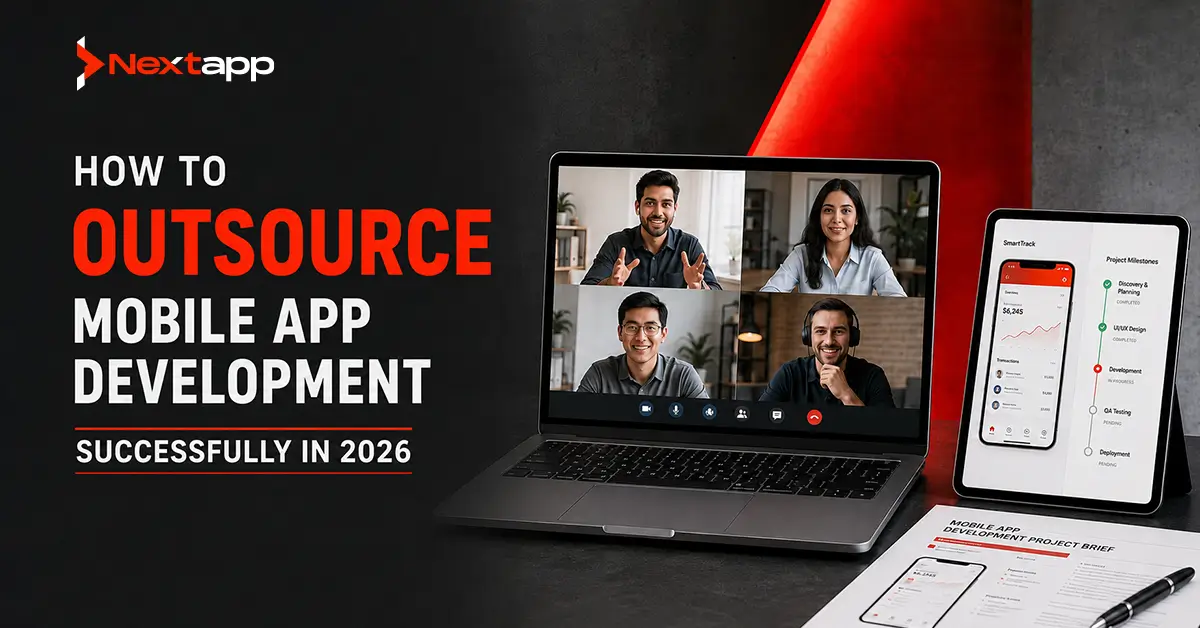
Outsourcing mobile app development is no longer a cost-cutting tactic reserved for budget-constrained startups. In 2026, it is a mainstream strategic decision made by companies of every size, from Series A startups to Global 500 enterprises, when internal capacity cannot accommodate a new build without delaying existing priorities. Understanding how to outsource mobile app development correctly determines whether the decision accelerates growth or creates an expensive management burden.
The global IT outsourcing market is projected to reach $425.19 billion between 2021 and 2026. The offshore mobile app development sector is expected to be worth $151.9 billion in 2025. These figures reflect a fundamental shift in how digital products are built. Companies that outsource mobile app development with disciplined vendor selection, clear contractual protections, and structured Agile collaboration consistently achieve better time-to-market and lower total cost of ownership than those building equivalent products in-house.
This guide covers the complete outsourcing process in practical sequence: choosing the right model, selecting the right vendor, protecting your intellectual property, managing the build, and securing the knowledge transfer that ensures your product does not become dependent on the vendor indefinitely.
When to Outsource Mobile App Development
Outsourcing is the right choice in five specific situations. First, your internal team is at capacity and cannot take on a new build without delaying existing roadmap commitments. Second, you need iOS, Android, or cross-platform expertise that would take four to six months to hire for internally. Third, the project is time-bound and launching three months late would cost more than any outsourcing cost premium. Fourth, the project requires specialist expertise (AI integration, blockchain, AR/VR, gaming) that your in-house team does not have and maintaining post-project would be operationally inefficient. Fifth, your business model calls for a focused core team that stays small and agile while product development scales through trusted partners.
Outsourcing is the wrong choice when the product requires deep proprietary technical architecture that must remain exclusively internal for competitive reasons, when your regulatory environment requires physical presence and direct employment for all personnel handling sensitive data, or when you do not have the internal product leadership capacity to manage an external team effectively. An outsourced development team requires active management, clear requirements, and regular review. Companies that outsource to avoid the work of managing development consistently get worse results than those that outsource while maintaining strong product ownership internally.
The Three Outsourcing Models: Offshore, Nearshore, and Onshore
Offshore Outsourcing
Offshore outsourcing means partnering with a development team in a geographically distant country, typically in a different time zone. The primary benefit is cost. Offshore teams in India, Ukraine, the Philippines, and Vietnam charge $15 to $50 per hour versus $100 to $250 per hour for North American teams, a saving of 50 to 70% in direct labor cost. For a mid-complexity mobile app requiring 2,500 hours of development, that cost differential is $125,000 to $375,000 in savings.
The operational requirement of offshore outsourcing is stronger project management discipline. Time zone gaps of 8 to 12 hours reduce synchronous communication windows to one or two hours per day. For projects with well-documented requirements and stable scope, this is manageable. For projects with evolving requirements that need daily product decisions, the synchronous window constraint creates bottlenecks that compound over a six-month build. India leads globally for cost-to-quality value. Eastern Europe is the leading choice for technically complex builds with EU time zone alignment. Both are established destinations for professional mobile app development outsourcing.
Nearshore Outsourcing
Nearshore outsourcing partners with development teams in neighboring or time zone-aligned countries. For US companies, nearshore means Latin America (Mexico, Colombia, Costa Rica, Argentina). For UK companies, nearshore means Eastern Europe. Nearshore rates are higher than offshore, typically $40 to $80 per hour, but significantly lower than onshore North American rates.
The commercial value of nearshore is real-time collaboration. Latin American developers working with US companies share three to five hours of daily working time overlap, enabling live debugging sessions, daily standup meetings, and sprint reviews that function identically to in-house team interactions. For startups with evolving product requirements where Agile iteration requires daily decision-making, nearshore consistently outperforms offshore despite its higher hourly rate because reduced communication friction more than compensates for the rate premium.
Onshore Outsourcing
Onshore outsourcing partners with a development team in the same country. It is the highest-cost option, with North American agencies charging $100 to $250 per hour. The benefits are maximum communication alignment, no time zone friction, shared cultural context, and simplified legal jurisdiction for contract disputes. Onshore is best suited for regulated industries like healthcare and finance where vendor vetting and compliance oversight require close interaction, or for complex products where the product leadership and engineering team must function as a single unit to manage architecture decisions effectively.
Hybrid Model
The hybrid model is the most widely adopted approach for mid-market companies that have learned from earlier outsourcing experiences. Product leadership, UX design, and architecture decisions stay with an in-house or onshore team. Core development execution runs through an experienced offshore or nearshore partner. This model captures the cost efficiency of offshore labor at the execution layer while maintaining the strategic direction and communication quality of close-to-home product management. It is the structure that most successfully scales for companies building multiple products simultaneously.
Engagement Models: Fixed Price, Time and Materials, Dedicated Team
Alongside the geographic outsourcing model, the engagement model determines how work is scoped, priced, and managed. Fixed-price engagements define the full scope and cost upfront. They are appropriate only when requirements are completely stable and acceptance criteria are clearly documented. Scope changes in fixed-price contracts trigger change orders that inflate cost and create relationship friction.
Time and Materials engagements bill actual hours worked at an agreed rate. They are best for evolving requirements, startup iteration, and projects where full scope cannot be accurately defined at the outset. Time and Materials requires active milestone-based budget management by the client to prevent cost drift.
Dedicated team engagements provide a retained monthly team billed at a fixed monthly rate for a specified composition: for example, two senior engineers, one UI designer, and one QA engineer. Dedicated teams are best for sustained product development over six or more months, post-launch live service operations, and companies that need consistent output velocity without the overhead of re-hiring for each new project phase.
How to Select the Right Outsourcing Vendor
The vendor selection process for how to outsource mobile app development successfully covers five sequential steps.
Step one is requirements documentation. Document your app's core purpose, target audience, key features, platform requirements, and launch timeline before approaching any vendor. A mid-level mobile app in 2026 typically costs $40,000 to $150,000. Set your budget with a 15 to 20% buffer for scope adjustments. Vendors who receive a clear requirements brief provide proposals that allow meaningful comparison. Vendors who receive vague briefs provide low-quality proposals that waste evaluation time.
Step two is building a shortlist of four to six qualified vendors using Clutch, GoodFirms, LinkedIn, and direct referrals. Filter on industry-specific experience rather than general capability. A vendor that has built ten apps in your sector outperforms one with one hundred unrelated builds. Look for outcome-based case studies that describe the business result, not just the feature list.
Step three is the discovery call assessment. Use discovery calls to evaluate technical depth and communication quality simultaneously. A vendor that agrees with every element of your brief without pushback is not demonstrating expertise. A vendor that identifies potential architecture problems, asks clarifying questions about your scalability requirements, and proposes alternative approaches to specific features is demonstrating the kind of technical engagement that predicts project quality.
Step four is reference verification. Contact at least two client references per shortlisted vendor. Ask whether the vendor delivered on time, how they handled scope change requests, what the communication rhythm was like, and whether the client would hire them again.
Step five is contract review. The contract must specify: IP ownership transfer upon payment, NDA terms protecting your product concept during and after the engagement, milestone payment schedule tied to deliverable acceptance, post-launch warranty period and its terms, and the process for dispute resolution if deliverables do not meet acceptance criteria.
Intellectual Property Protection in Mobile App Outsourcing
IP protection is the most critical legal dimension of how to outsource mobile app development. Two documents protect your IP before work begins. The first is the NDA. Execute a mutual NDA before sharing any product concept, design assets, or proprietary business logic with any vendor. The NDA should prohibit the vendor from using your product concept for competing projects and from disclosing your product information to third parties.
The second is the IP assignment clause in the development contract. This clause must explicitly state that all custom code, design assets, and deliverables produced under the contract become the full property of the client upon receipt of payment. Without explicit IP assignment language, some jurisdictions default to creator ownership rules that leave the vendor with residual rights over the code they wrote.
Additional IP protection practices include: using role-based access controls to limit developer access to only the components they are actively building, maintaining your own source code repository rather than relying on vendor-hosted repositories, and conducting a code audit at project completion to confirm that no unlicensed third-party components or open-source libraries with incompatible licenses are embedded in the delivered product.
Managing the Build: Agile Collaboration and Quality Control
Agile adoption has been shown to improve revenue and efficiency by approximately 60%, and Agile is now the standard for any professional outsourced mobile app build. Sprint-based development with two to four week cycles delivers testable milestones that allow clients to review progress, request adjustments, and confirm scope understanding before the next sprint begins.
Effective quality control in an outsourced build covers three parallel workstreams. Code quality reviews use automated tools including ESLint, SonarQube, and Dart Analyzer to enforce code standards continuously throughout the build. Functional QA testing runs after each sprint to confirm that delivered features work as specified. Device compatibility testing validates performance across the target device matrix before the beta build is declared ready for external review.
Time zone management for offshore teams requires establishing a daily asynchronous communication protocol that does not depend on real-time interaction for progress. Daily written status updates, shared sprint boards, and weekly video sprint reviews provide adequate visibility for projects with stable requirements. For projects requiring frequent product decisions, build in a two-hour daily overlap window as a non-negotiable operating requirement during the vendor selection process
Post-Delivery Support and Knowledge Transfer
The final phase of successful mobile app development outsourcing is the knowledge transfer that ensures the product does not remain operationally dependent on the vendor after handover. Knowledge transfer covers four components.
Source code documentation ensures that any developer can understand the codebase architecture, component relationships, and build configuration without requiring the original development team to explain it verbally. Comprehensive README files, inline code comments, and architecture decision records are the minimum standard.
Deployment documentation covers the complete process for deploying new builds to the App Store and Google Play, configuring the backend infrastructure, and maintaining the server environment. Vendors who do not provide deployment documentation are creating a dependency that translates directly into ongoing service fees.
Post-launch warranty support defines the vendor's responsibility for defects discovered after handover. A 30- to 90-day warranty period, during which development-introduced defects are fixed at no additional charge, is the professional standard. Confirm the warranty terms in the contract before signing.
Ongoing maintenance retainer options define the commercial path for continued development after the warranty period. Confirm the vendor's availability and preferred engagement structure for ongoing work before the initial project ends, especially if you anticipate feature additions, live service operations, or OS compatibility updates in the months following launch.
Conclusion
Mastering how to outsource mobile app development means understanding that outsourcing is a partnership model, not a delegation model. The companies that succeed treat their outsourced development team as an extension of their product organization, with clear requirements, active milestone reviews, Agile collaboration, and deliberate IP protection at every phase.
The financial case for outsourcing is clear: 50 to 70% cost savings versus in-house North American development, access to specialized expertise that would take months to hire internally, and the flexibility to scale development capacity without the overhead of permanent employment. The operational case is equally clear: outsourcing works best when product leadership stays close to home and development execution runs through a trusted, experienced partner.
If you are ready to outsource your mobile app build to a team that treats your product's success as their own responsibility, Next App delivers full-cycle mobile app development services across iOS app development, Android app development, Flutter, React Native, game development, e-commerce, and custom software. Contact our team to discuss your project.
Frequently Asked Questions (FAQs)
What is the most cost-effective country to outsource mobile app development to in 2026?
India leads globally for cost-to-quality value, with hourly rates of $15 to $40 for experienced mobile developers. Eastern Europe (Poland, Ukraine, Romania) delivers the highest technical quality in the $40 to $80 hourly range and is the preferred outsourcing destination for technically complex European-market builds. Latin America (Colombia, Mexico, Argentina) is the leading nearshore option for US companies needing real-time collaboration at rates of $40 to $70 per hour.
How do I protect my app idea when outsourcing development?
Execute a mutual NDA before any product concept disclosure. Include explicit IP ownership assignment in the development contract specifying that all deliverables become client property upon payment. Maintain your own source code repository throughout the build. Conduct a code audit at project completion. These four practices collectively protect your product IP across the full outsourcing lifecycle.
What is the difference between offshore, nearshore, and onshore outsourcing?
Offshore outsourcing partners with teams in distant countries with significant time zone differences, delivering the highest cost savings at 50 to 70% versus North American rates. Nearshore outsourcing partners with teams in neighboring or time zone-aligned countries, balancing moderate cost savings with real-time collaboration. Onshore outsourcing uses teams in the same country, offering maximum communication alignment at the highest cost.
Should I use a fixed-price or Time and Materials contract for outsourced app development?
Fixed-price contracts work for stable, fully documented scopes where requirements will not change during the build. Time and Materials contracts work for evolving requirements, startup iteration, and projects where scope cannot be fully defined upfront. Most professionally managed outsourced builds use Time and Materials for the development phase with milestone-based budget checkpoints to prevent cost drift.
What should I look for in an outsourced iOS or Android app development company?
Look for platform-specific expertise: Swift for iOS builds, Kotlin for Android builds, and Flutter or React Native for cross-platform builds. Verify with portfolio case studies that show comparable complexity to your project. Confirm review ratings on Clutch or GoodFirms. For iOS app development company selection specifically, confirm App Store submission experience and familiarity with Apple's review guidelines. For android app development company selection, confirm Google Play certification experience and compatibility testing across the Android device matrix.