

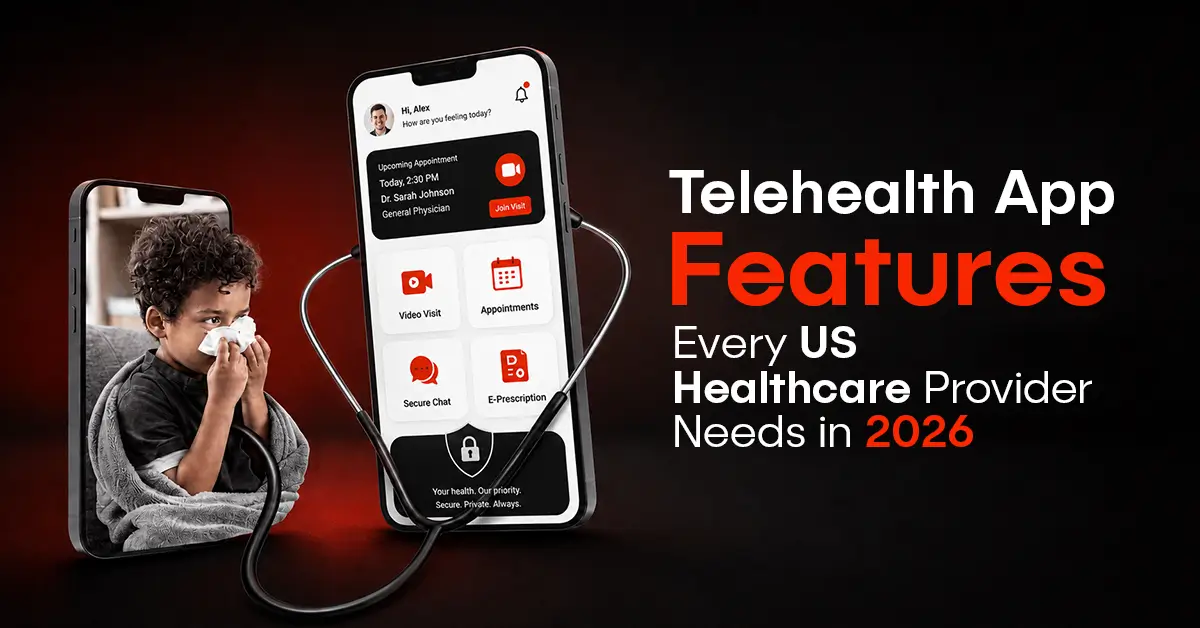
Telehealth is no longer something you add to a healthcare offering to stay competitive. In 2026, you are expected to offer it. Patients now assume virtual care is available, and providers increasingly rely on it to manage capacity, reduce burnout, and extend access beyond physical facilities.
What has changed is not just adoption, but expectations. Patients compare telehealth experiences to consumer apps they already trust. If scheduling feels clunky, video quality drops, or follow-ups require extra effort, engagement declines quickly. Providers face a different challenge. They need telehealth tools that integrate smoothly into existing workflows instead of creating parallel systems.
This is why telehealth app features must be designed as part of a larger healthcare app strategy. When features are built in isolation, telehealth becomes a short-term solution. When built correctly, it becomes a scalable care delivery channel that improves outcomes, efficiency, and satisfaction for everyone involved.
High-Quality Video and Audio Consultations as the Foundation
Every telehealth experience begins with real-time communication. In 2026, high-quality video and audio are baseline expectations, not differentiators. Patients expect stable connections across mobile devices, tablets, and desktops, while providers require reliability that supports clinical decision-making.
You need to consider more than just video resolution. Adaptive streaming, network resilience, and device compatibility all play a role in delivering consistent experiences. Screen sharing is also essential for reviewing lab results, imaging, care plans, or educational materials during visits.
Recording capabilities, when used appropriately and in compliance with regulations, support documentation and continuity of care. These features must be implemented with clear consent workflows and secure storage to align with HIPAA requirements.
Appointment Scheduling and Visit Management Features
Telehealth success often depends on what happens before the visit starts. Scheduling tools shape first impressions and directly affect attendance rates. In 2026, telehealth apps must support intuitive appointment booking with real-time availability.
Automated reminders via push notifications, SMS, or email reduce no-shows and last-minute cancellations. Waitlist management adds flexibility by filling open slots without manual coordination. These features save time for administrative teams while improving access for patients.
Check-in workflows are equally important. Digital intake, consent forms, and insurance verification completed before the visit reduce friction and allow providers to focus on care instead of paperwork.
Secure Messaging and File Sharing for Virtual Care
Telehealth does not begin or end with a video call. Secure messaging extends care beyond scheduled visits and supports follow-ups, clarifications, and care coordination. Patients expect to communicate easily with care teams without relying on phone calls.
File sharing capabilities allow patients to upload images, documents, or symptom details directly through the app. This is especially important for dermatology, wound care, post-operative follow-ups, and chronic condition management.
From a provider perspective, structured file intake improves preparation and reduces visit time. When messaging and file sharing are integrated into the same platform, communication becomes easier to track and manage.
AI-Assisted Triage and Pre-Visit Workflows
Telehealth app features in 2026 increasingly rely on intelligent automation to manage demand. AI-assisted triage helps route patients to the right level of care based on symptoms, history, and urgency.
Pre-visit questionnaires collect relevant information before appointments, reducing repetitive questions and improving efficiency. When paired with decision support tools, these workflows help providers prepare more effectively while maintaining clinical oversight.
It is important that AI features support clinicians rather than replace judgment. Transparency, explainability, and clinical validation are essential to maintain trust and compliance.
Asynchronous Telehealth Features for Non-Urgent Care
Not every care interaction requires a live session. Asynchronous telehealth features allow patients to submit questions, updates, or concerns that providers can review and respond to within appropriate timeframes.
Store-and-forward messaging is particularly useful for follow-ups, medication adjustments, and chronic care check-ins. These features improve access while reducing scheduling pressure on providers.
When implemented correctly, asynchronous care complements live visits and expands capacity without sacrificing quality.
Accessibility and Global Readiness in Telehealth Apps
Telehealth must work for diverse populations. In 2026, accessibility is both a usability and compliance requirement. Multilingual interfaces ensure patients can communicate comfortably, while voice input and screen reader compatibility support users with visual or motor impairments.
Low-bandwidth modes are critical for rural or underserved areas where connectivity may be limited. Telehealth apps should adapt to network conditions rather than fail outright.
When accessibility is prioritized, telehealth becomes a tool for equity instead of a barrier.
Privacy, Security, and Compliance in Telehealth Features
Telehealth apps handle highly sensitive data, making security foundational. End-to-end encryption protects video, audio, messaging, and shared files during transmission. Role-based access controls ensure only authorized users can view or modify information.
Audit logs and session tracking support compliance and accountability. Consent management ensures patients understand how their data is used, especially when recordings or AI tools are involved.
Security must be built into every telehealth feature rather than layered on later. This approach reduces risk and supports trust at scale.
Integration With EHR and Care Systems
Telehealth does not operate in isolation. Integration with EHR systems ensures documentation, orders, and follow-ups are captured accurately. Real-time data exchange reduces duplication and errors.
FHIR-based integration supports scalable interoperability, while legacy HL7 support ensures compatibility with existing infrastructure. Scheduling, notes, and visit summaries should flow seamlessly between systems.
When telehealth integrates cleanly into clinical workflows, adoption accelerates.
Measuring Telehealth Performance and Outcomes
Telehealth app features should support analytics and reporting from the start. Usage metrics, appointment completion rates, patient satisfaction, and clinical outcomes help organizations evaluate effectiveness.
Dashboards allow administrators and clinical leaders to identify trends, optimize workflows, and justify investment. Data-driven insights also inform feature iteration and expansion.
When performance is visible, telehealth evolves from experimentation to strategic infrastructure.
Conclusion
Telehealth success in 2026 depends on more than availability. It depends on how thoughtfully features are designed, integrated, and supported. When telehealth feels disconnected or unreliable, adoption stalls.
When features align with patient needs, provider workflows, and regulatory expectations, telehealth becomes a sustainable care channel. It improves access, reduces strain on systems, and supports better outcomes.
For healthcare organizations building or scaling telehealth solutions, feature strategy is not a technical detail. It is a business and clinical decision that shapes long-term impact.