

Key Takeaways
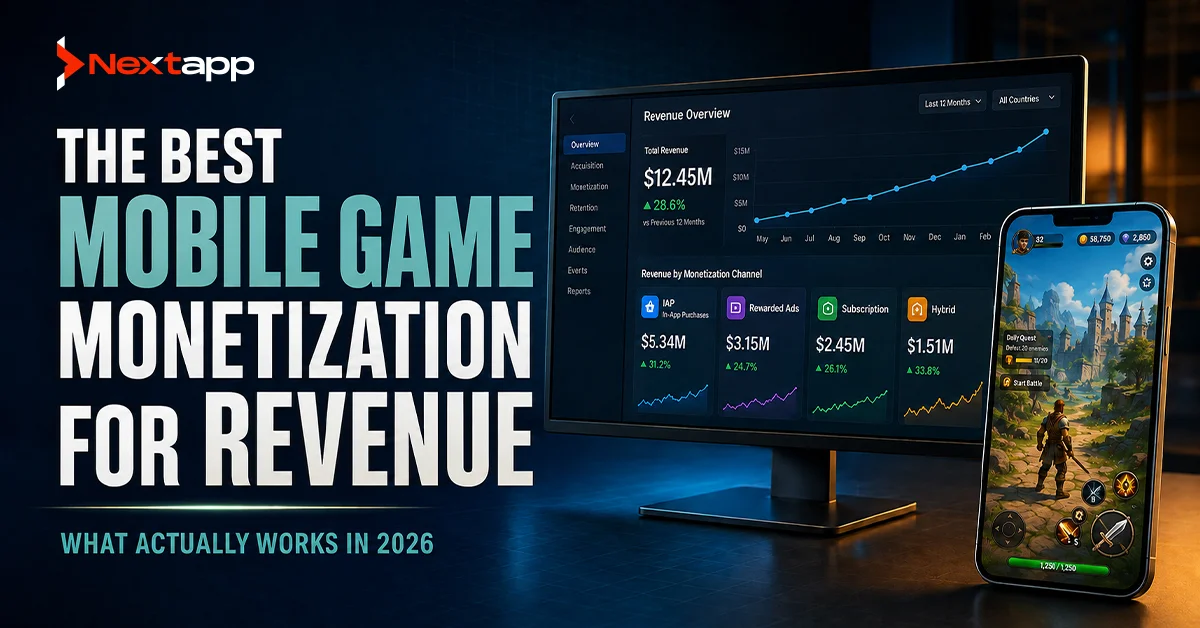
- The best mobile game monetization for revenue in 2026 is a layered hybrid approach that combines rewarded ads, high-value IAP, and a battle pass or subscription, calibrated to player segment behaviour from day one.
- Hybrid-monetised mid-core games achieve ARPDAU of $0.15 to $0.30. Casual hybrid titles achieve $0.08 to $0.15. Both represent 2 to 3x the ARPDAU of single-model equivalents.
- High-value IAP design through starter bundles, limited-time offers, and VIP tiers consistently drives first-purchase conversion of 20 to 40% for new players, establishing a purchase relationship that increases lifetime IAP spend by 3 to 5x.
- Rewarded ad optimisation through in-app bidding mediation generates 20 to 40% higher eCPM than single-network setups, turning the non-paying 95% of players into a meaningful daily revenue contributor.
- User segmentation into payer and non-payer cohorts within the first three sessions allows studios to serve each segment with the monetisation approach most likely to convert them without alienating either group.
- Seasonal event monetisation generates 5x normal daily ARPDAU during active event periods. Q4 holiday events have produced 10 to 20x daily revenue spikes for top-grossing live-service games.
- Monetisation architecture designed during pre-production generates 3 to 5x higher first-year revenue than equivalent games that added monetisation post-launch, across every documented studio comparison.
Introduction
The question every mobile game developer eventually faces is also the most commercially consequential one: what is the best mobile game monetization for revenue in my specific situation? The mobile gaming market has never offered more monetisation options. IAP, advertising, subscriptions, battle passes, cosmetics, DLC, web shops. Every option has a success story and a failure story. The difference between them is almost always whether the model was chosen to match the game's genre, audience, and content capacity, or whether it was selected by default.
This guide answers the revenue question with data rather than opinion. It covers the five highest-impact monetisation components: hybrid monetisation architecture, high-value IAP design, rewarded ad optimisation, user segmentation strategy, and seasonal events monetisation. Each component is supported by 2026 market benchmarks and connected to practical implementation decisions studios can make during production rather than after launch.
The goal is not to identify the best mobile game monetization for revenue in the abstract. It is to help you identify the best model for your specific game, your specific audience, and your specific business goals. That distinction is what separates a monetisation strategy that compounds over time from one that produces a flat revenue curve six weeks after launch.
Component 1: Hybrid Monetization Architecture
The best mobile game monetization for revenue in 2026 combines at least two and ideally three simultaneous revenue streams targeting different player segments. Single-model games leave significant revenue on the table regardless of which model they choose. IAP-only games generate zero revenue from 95% of players. Ad-only games undermonetise the 5% who would pay for premium content. Subscription-only games lose players who want ad-free access but resist recurring commitments.
Hybrid architecture solves this by creating a parallel monetisation system where non-payers generate ad revenue, occasional buyers convert on IAP starter bundles, committed players subscribe to battle passes, and high-value spenders access VIP-tier cosmetics and limited-time exclusive bundles. Each segment contributes to total ARPDAU through the mechanism best matched to their behaviour.
The Tri-Model Framework that consistently produces the best mobile game monetization for revenue outcomes combines rewarded video ads (monetising the non-paying majority), IAP starter bundles and mid-tier purchases (monetising occasional buyers), and a battle pass or subscription (monetising committed players). Mid-core games using this structure achieve $0.20 to $0.30 ARPDAU. Casual hybrid games achieve $0.08 to $0.15. Both outperform single-model equivalents by 50 to 200%.
Implementing hybrid architecture requires three pre-production decisions: choosing the primary revenue model that aligns with the genre, designing the secondary model to serve the player segments the primary model does not capture, and planning the content update cadence that the battle pass or subscription layer requires. For genre-specific model recommendations, see the companion guide on mobile game monetization models.
Component 2: High-Value IAP Design
IAP design is the variable that most consistently separates high-revenue and low-revenue games within the same genre. Two games with identical player bases can generate 5x different IAP revenue based purely on how their purchase experiences are designed. The principles that produce the highest IAP revenue per paying player in 2026 are consistent across genres and audience types.
Starter bundles are the highest-impact single IAP product a studio can launch with. Priced at $0.99 to $1.99 with 5x to 10x perceived value in included items, starter bundles convert 20 to 40% of new players who would not purchase at standard pricing. Critically, players who make a first purchase are 3-5x more likely to make subsequent purchases. The starter bundle establishes the spending relationship that makes all future IAP marketing more effective. Not launching a starter bundle is one of the most common and expensive IAP design mistakes in mobile gaming.
Intent-based purchase prompt timing generates 3 to 5x higher conversion than random prompt timing. A purchase prompt appearing when a player just failed a level for the third time, needs one more energy to complete a quest, or is one cosmetic away from completing a collection set, is intercepting a player at a moment of genuine purchase motivation. The same prompt appearing during a successful run meets zero motivation. Mapping purchase prompt triggers to friction and desire moments in the core loop is the most practical IAP optimisation available without changing the game's fundamental design.
Multi-tier pricing, ranging from $0.99 to $99.99, ensures that every spending category is served. 60% of IAP transactions under $5 are impulse purchases driven by perceived value at the moment of encounter. Mid-tier purchases at $9.99 to $24.99 require value justification and are driven by bundle composition quality. High-value purchases above $49.99 require VIP framing, exclusivity signalling, and social status differentiation that makes the price feel proportionate to the perceived benefit. Without a full pricing tier stack, studios systematically miss purchasing opportunities across every segment.
For complete IAP statistics and conversion benchmarks by genre, the guide on mobile game monetization statistics provides ARPPU, conversion rate, and first-purchase timing data across all major mobile game categories.
Component 3: Rewarded Ad Optimisation
Rewarded advertising is not passive revenue. It is an actively managed system where placement decisions, network selection, mediation configuration, and frequency calibration determine whether the ad layer contributes $0.04 or $0.12 ARPDAU from the same player base. The gap between unoptimised and optimised rewarded ad implementation is consistently 2 to 3x in documented studio comparisons.
Mediation setup is the single highest-impact technical decision in ad revenue optimisation. Running a single ad network generates revenue at that network's prevailing rates with no competitive pressure. Running 10 to 20 networks through a mediation platform like AppLovin MAX or Unity LevelPlay creates first-price auctions where every network competes for each impression simultaneously. Studios switching from single-network to mediated setups report 20 to 40% eCPM improvement in the first month of operation. At $0.10 average daily ad revenue per player and 100,000 DAU, that 40% improvement is $1.46 million in additional annual revenue from an infrastructure change rather than a product change.
Rewarded video placement optimisation focuses on two variables: trigger moments and reward calibration. Trigger moments at post-failure, near-progression-threshold, and daily bonus collection positions consistently outperform session-boundary and random trigger placements in opt-in rate. Reward calibration sets the in-game value of the rewarded item just above the player's natural acquisition rate: rewarding currency at a rate that meaningfully accelerates progression without replacing the purchase motivation for the same currency in the IAP store.
The frequency management principle that protects ARPDAU without sacrificing revenue: maximum one interstitial per three minutes, no interstitial in the first two minutes of any session, rewarded video available on demand but never forced. Monitor Day 7 retention alongside ARPDAU simultaneously. The optimal frequency is the maximum that does not reduce Day 7 retention. Any additional impressions above that threshold reduce lifetime ad revenue by increasing churn faster than they increase daily impression volume. For complete platform benchmarks and mediation setup guides, see the guide on mobile app monetization platforms.
Component 4: User Segmentation Strategy
The best mobile game monetization for revenue treats the player base not as one audience but as several simultaneous audiences, each requiring a different monetisation approach. The studios that consistently achieve the highest ARPDAU in their genres use behavioural cohort segmentation from the first session to ensure every player receives the monetisation approach most likely to convert them.
Early cohort identification within the first one to three sessions classifies players into monetisation segments using behavioural signals: tutorial completion speed, social feature engagement, early premium element interaction, and session frequency in the first 48 hours. Likely payers receive IAP-forward experiences with fewer ad interruptions and more purchase prompts at high-intent moments. Likely non-payers receive ad-optimised experiences with maximum rewarded video exposure, minimal purchase pressure, and IAP prompts framed as value propositions rather than urgent calls-to-action.
Whale player identification and VIP management represent the highest-ROI segmentation activity for mid-core and core games. High-value spenders who account for 50 to 70% of total IAP revenue in most games require dedicated management: exclusive cosmetic access, personal community manager outreach on new releases, VIP-tier status recognition, and early access to seasonal content. Studios with dedicated whale relationship management programs consistently achieve higher ARPPU from their top spenders than those who treat high-value players identically to the rest of the paying base.
Non-paying player retention optimisation is equally important to payer conversion in ad-monetised games. Non-payers who remain active generate daily ad revenue indefinitely. Non-payers who churn generate nothing. Social features (guilds, clans, leaderboards), daily quest systems, and streak mechanics that reward consistent login behaviour are the highest-impact non-payer retention tools. A non-paying player retained to Day 90 generates 90x the ad revenue of a non-paying player retained to Day 1. The retention investment pays back entirely through ad revenue before a single IAP prompt is shown.
Component 5: Seasonal Events Monetization
Seasonal events are the most powerful ARPDAU growth lever available to live-service mobile games in 2026. The data is consistent across genres: seasonal events boost daily spending 5x above the non-event baseline. Q4 holiday events produce 10 to 20x daily revenue spikes for the highest-performing live-service games. A game with $10,000 daily baseline revenue generating a two-week Q4 event at 10x baseline earns an additional $1.26 million from a single event window that required content creation but zero additional user acquisition.
Seasonal event monetisation works through five simultaneous mechanisms. Limited-time cosmetics create urgency through scarcity: a character skin available for seven days commands a 40 to 60% price premium over equivalent permanent items. Event-exclusive currencies drive purchase behaviour through currency accumulation mechanics that create near-completion purchase triggers. Community challenges unlock shared rewards when the active player base collectively achieves a target, driving daily login and session frequency. Seasonal battle pass tiers provide a structured reward track that converts non-subscribers into seasonal pass buyers at rates above the standard pass. Limited-time bundles package event content with premium currency at value ratios that drive impulse conversion among players who would not buy the components individually.
The prerequisite for seasonal event monetisation is a content production pipeline built before launch. Studios that plan their first 12 to 18 months of seasonal content calendar during pre-production ship events without timeline crisis, maintain content quality under delivery pressure, and build the community expectation of regular events that drives the login habit seasonal monetisation depends on. Studios that build seasonal event infrastructure reactively after launch experience delayed first event timelines, lower-quality content, and the lost revenue of the first post-launch Q4 that passed without an event in place.
For developers planning their seasonal content strategy, understanding game development stages in the context of post-launch live operations helps identify when event content planning should begin (pre-production), when the first seasonal event should ship (four to six weeks after launch), and what cadence the content team needs to maintain to keep the event calendar delivering the ARPDAU growth it is capable of generating.
Connecting Revenue to the Full Development Strategy
The best mobile game monetization for revenue is not a post-launch optimisation. It is a pre-production design decision that shapes every downstream development choice. Studios that understand this consistently outperform those that treat monetisation as a feature to be added rather than a system to be designed.
For developers starting a new project, the connection between monetisation and production runs in both directions. mobile game development cost decisions affect which revenue models are achievable within budget. what is game development at a systems level informs how economy design, content update architecture, and player progression connect to monetisation triggers. how to make a game app from scratch guides the technical implementation decisions that determine whether IAP, ad, and subscription systems function correctly in production environments.
For studios looking to improve revenue from existing titles, the tools available in 2026, mediation platforms, personalisation SDKs, live ops management systems, and web shop infrastructure, all extend the best mobile game monetization for revenue framework to games that launched without it. The investment in these systems pays back in ARPDAU improvement within 30 to 60 days of implementation in virtually every documented case.
Understanding how to make money playing video games as a player also gives developers insight into which monetisation systems players find fair, engaging, and worth their spending. The best-converting monetisation systems are the ones that make players feel rewarded for spending, not coerced into it. That distinction is what produces the long-term retention and LTV that sustainable revenue depends on. See the guide on game apps that pay real money for the player-perspective view of how spending decisions are made in the mobile gaming market.
Conclusion
The best mobile game monetization for revenue is not one decision. It is five interconnected systems, each optimised for a specific player segment and revenue objective, all operating simultaneously within a single product. Hybrid monetisation architecture captures all player types. High-value IAP design converts and retains paying players at the maximum rate. Rewarded ad optimisation generates daily income from the non-paying majority. User segmentation ensures every player receives the monetisation approach most likely to convert them. Seasonal events multiply baseline ARPDAU through time-limited urgency and community engagement.
The studios that implement all five components from pre-production consistently generate 3 to 5x higher first-year revenue than those that address monetisation reactively. The mobile game monetization statistics confirm this pattern across genres, platforms, and studio sizes. The mobile game monetization trends data confirms that the competitive advantage of early monetisation design is growing, not narrowing, as the market matures.
If you are building a game and want to implement the best mobile game monetization for revenue from concept through live-ops, Next App delivers full-cycle mobile game development services including economy architecture, IAP design, ad platform integration, segmentation systems, and seasonal event planning. Contact our mobile game development company to start building a game that earns from day one.
Frequently Asked Questions (FAQs)
How much does rewarded ad optimisation improve revenue?
Mediated multi-network setups generate 20 to 40% higher eCPM than single-network configurations. Intent-based rewarded video placement increases opt-in rates by 15 to 25% over session-boundary placement. Combined, these optimisations can increase total ad ARPDAU by 50 to 80% from the same active player base without increasing install volume.
What are seasonal events and why do they matter for revenue?
Seasonal events are time-limited in-game experiences (holiday themes, anniversary events, community challenges) that create urgency, drive daily logins, and activate spending behaviours through limited-time cosmetics and bundles. They generate 5x normal daily ARPDAU and Q4 events produce 10 to 20x spikes in top studios. They are the most reliable post-launch revenue growth lever available to live-service games.
How does user segmentation improve monetization revenue?
Segmentation serves each player the monetisation approach most likely to convert them. Payers receive IAP-forward experiences at high-intent moments. Non-payers receive optimised ad exposure. Whale players receive VIP treatment and personalised offers. Studios with active segmentation systems consistently outperform unsegmented approaches by 30 to 50% in total monthly revenue from equivalent player bases.
When should I start thinking about monetization strategy?
During pre-production, before writing any production code. The monetisation model determines economy design, content architecture, UI structure, and platform requirements that are expensive to change after production begins. See the guide on most profitable mobile game monetization strategy for how to select and implement the right architecture before the first sprint begins.
Does monetization strategy affect how to advertise a game?
Yes directly. High ARPDAU from strong monetisation allows studios to spend more on user acquisition at profitable CPI thresholds. A game generating $0.30 ARPDAU with strong Day 30 retention has a 30-day LTV above $9, allowing profitable acquisition at CPI up to $3 to $4. A game generating $0.05 ARPDAU cannot profitably spend above $0.50 CPI on most channels. See the guide on how to advertise your mobile games for how acquisition economics connect to monetisation performance.
Where can I get help building a profitable monetization system?
Professional mobile game development services from a studio that integrates monetisation design into pre-production are the fastest path to a revenue-optimised launch. Next App builds complete mobile games with monetisation architecture, economy design, ad platform integration, and live-ops strategy built from concept through launch. Contact our team to discuss your project today.